
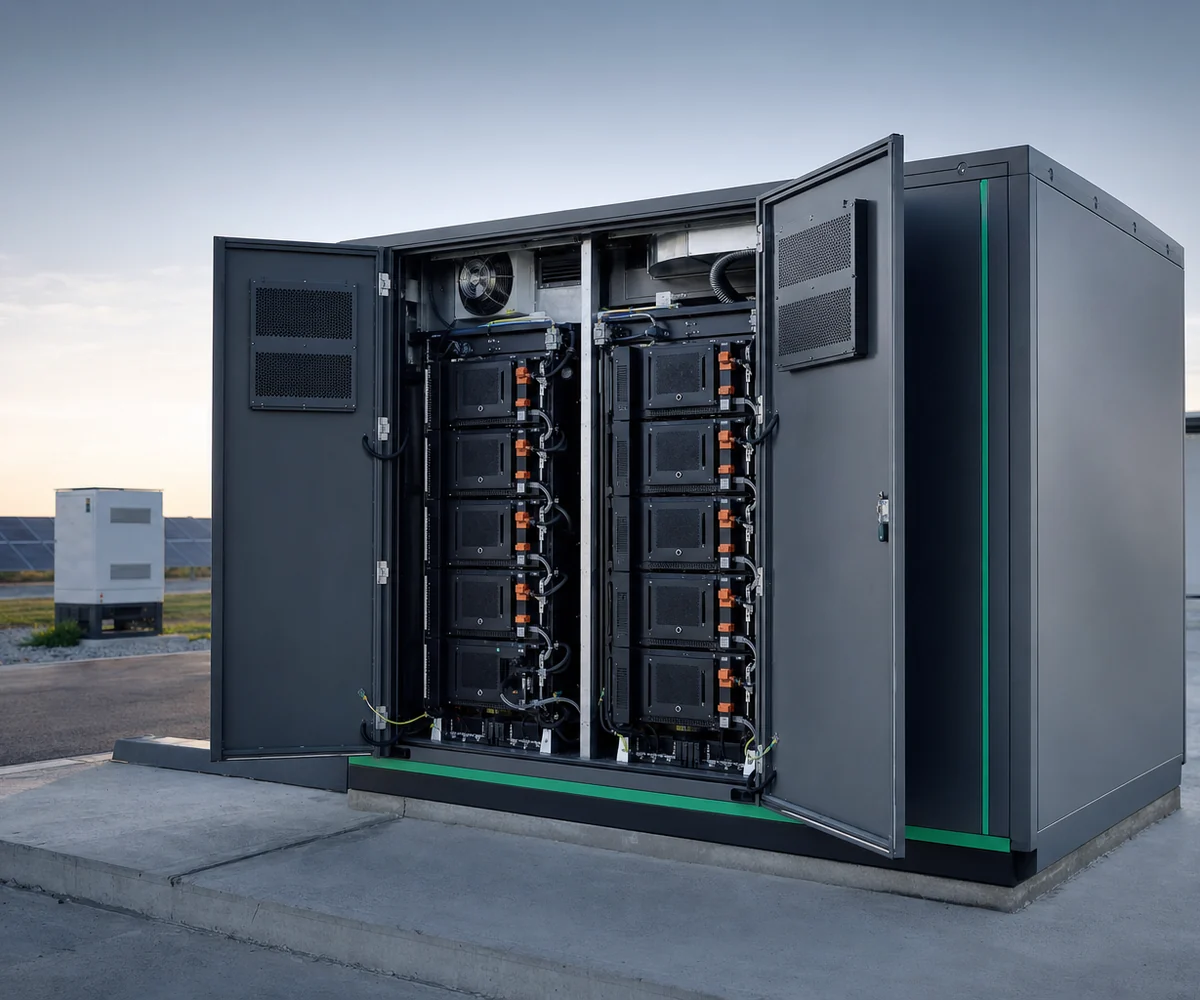
Outdoor battery energy storage cabinet
Outdoor Battery Energy Storage Cabinet: site checks before quotation.
Compare verified cabinet ratings, IP54/C3 enclosure basis, liquid cooling, fire interfaces, PCS and EMS scope, service access and factory evidence before quotation.
An outdoor battery energy storage cabinet should be reviewed as a complete project system, not only as a metal enclosure with batteries inside. Buyers need to confirm battery and BMS identity, PCS and EMS responsibility, liquid-cooling design, enclosure and corrosion basis, fire interfaces, FAT records and warranty support.
This page is for EPC buyers, distributors and installers comparing cabinet ESS options before quotation. For project data, use the site survey checklist and send questions through Contact.
The three documented C&I cabinet platforms use intelligent liquid cooling and state an IP54 enclosure, C3 anti-corrosion basis, −20 °C to 55 °C operating range and 0–95% non-condensing humidity basis. These are product-reference inputs; the approved project datasheet must confirm the final configuration and suitability for the installation site.
What an outdoor battery energy storage cabinet should include
A complete cabinet offer should define battery modules, BMS, PCS or inverter scope, EMS functions, liquid-cooling equipment, enclosure and corrosion basis, cable entry, fire interfaces and service access. If these items are not shown clearly, two quotes with the same kWh rating may represent very different systems.
Buyer checklist
| Check item | What to request | Why it matters |
|---|---|---|
| Battery and BMS | Cell type, pack layout, voltage range, current limits and protocol notes. | Connects capacity with real inverter and PCS behavior. |
| Cooling and enclosure | Liquid-cooling layout, heat rejection, IP/C3 basis, service access and condensation control. | Outdoor cabinets fail quickly when heat, dust, humidity or water assumptions are weak. |
| PCS/EMS scope | Power rating, grid mode, overload limit, EMS functions and responsibility boundary. | Prevents a cabinet quote from hiding important power-conversion costs. |
| Fire documents | Detection, suppression, emergency stop, alarm logic and local document list. | Supports safety review and installation approval. |
| FAT and warranty | Test records, serial-number photos, warranty exclusions and service process. | Gives the buyer evidence before shipment and support after installation. |
Related project checks
Before approving an outdoor cabinet, compare cooling and HVAC requirements, PCS and battery matching, and the supplier qualification checklist.
How cabinet scope changes real project cost
Two outdoor cabinet quotes can both say the same kWh capacity but still describe different systems. One may include PCS, EMS, HVAC, fire equipment, wiring, commissioning support and export documents. Another may describe only a battery cabinet and leave several project costs outside the quotation. The buyer should mark every included and excluded item before comparing price.
Cooling deserves early attention because it affects both operation and warranty. A cabinet installed in a hot, dusty or humid location needs a realistic airflow path, filter access, service clearance and alarm record. If the supplier cannot explain maintenance access, the cabinet may be difficult to support after installation.
Ask for a cabinet drawing before order confirmation. The drawing should show battery modules or racks, PCS or inverter position if included, cable entry, HVAC or fan location, fire equipment, door direction and service clearance. This does not replace a local installation drawing, but it gives the buyer enough evidence to spot missing scope.
Documents to request before deposit
Before paying a deposit, request the datasheet, cabinet layout, wiring diagram, cooling description, BMS information, PCS scope, fire safety document list, expected FAT procedure and warranty terms. For export orders, add packing method, label photo requirements, UN38.3 or MSDS availability and country-specific shipping documents.
Quotation review notes for outdoor cabinets
When reviewing an outdoor cabinet quote, separate the battery cabinet from the complete project package. Some offers include only battery modules and a cabinet shell, while others include PCS, EMS, HVAC, fire safety hardware, wiring, commissioning support and export documents. A buyer should mark these differences in a comparison sheet before discussing price.
Also check whether the supplier has stated what the buyer must provide on site. Foundation, cable trench, AC connection, grounding, network access, canopy, crane support and local approval may sit outside the supplier scope. If these items are not discussed early, the final installed cost can be higher than expected.
| Quote item | Question to ask | Risk if unclear |
|---|---|---|
| Included scope | Which battery, PCS, EMS, cooling, fire and document items are included? | The buyer may compare a complete system with a partial supply. |
| Responsibility | Who supports setup, troubleshooting, spare parts and warranty claims? | Problems can move between supplier, integrator and installer. |
| Evidence timing | Which documents are available before deposit, before shipment and after commissioning? | Important evidence may arrive too late to influence the purchase decision. |
FAQ
What should an outdoor battery energy storage cabinet include?
The quotation should define battery and BMS identity, PCS and EMS responsibility, liquid cooling, enclosure and corrosion basis, fire interfaces, cable entry, service clearance, FAT evidence and warranty scope.
Is IP54 enough for every outdoor BESS site?
No. IP54 and C3 are useful product-reference inputs, but the final design must also match site rain, dust, humidity, temperature, altitude, corrosion exposure, drainage and maintenance access.
Should PCS be inside the cabinet?
It depends on capacity, heat, service access and supplier design. Ask for a layout and responsibility boundary.
What documents should I request before order?
Datasheet, layout, wiring diagram, cooling information, fire documents, FAT scope and warranty terms.
Can StorageCabinetPro review a cabinet quote?
Yes. Send project data and supplier documents through the contact page.
Verified cabinet reference
Compare the three documented outdoor cabinet platforms.
These are current starting configurations—not generic capacity ranges. Confirm the final project datasheet before order.
| Configuration | Battery window | AC interface | Base enclosure | Approx. weight |
|---|---|---|---|---|
| 105 kW / 233 kWh | 650–949 Vdc | 400 V AC | 1000 × 1400 × 2415 mm | ≈2.7 t |
| 125 kW / 261.2 kWh | 650–949 Vdc | 400 V AC | 1000 × 1400 × 2415 mm | ≈2.7 t |
| 250 kW / 522.5 kWh | 650–949 Vdc | 400 V AC | 1940 × 1504 × 2555 mm | ≈5.4 t |
Related buyer guides
Continue with the next engineering decision.
Use the guide that matches the open sizing, electrical, safety or quotation question.
Commercial battery storage cost
Separate battery, PCS, enclosure, electrical BOS, delivery and commissioning cost drivers.
Read guideBESS fire protection documents
Check design basis, detection, suppression, alarms, emergency stop and FAT evidence.
Read guidePeak shaving battery sizing
Translate interval load data, target demand and peak duration into kW and kWh.
Read guideContinue the project review
Connect the next decision.
Use the related page that matches the next equipment, engineering or evidence question.
Bring the site data. Leave with a clearer BESS scope.
Share the load profile, grid voltage, target kW and kWh, installation country, ambient conditions and expected schedule.