
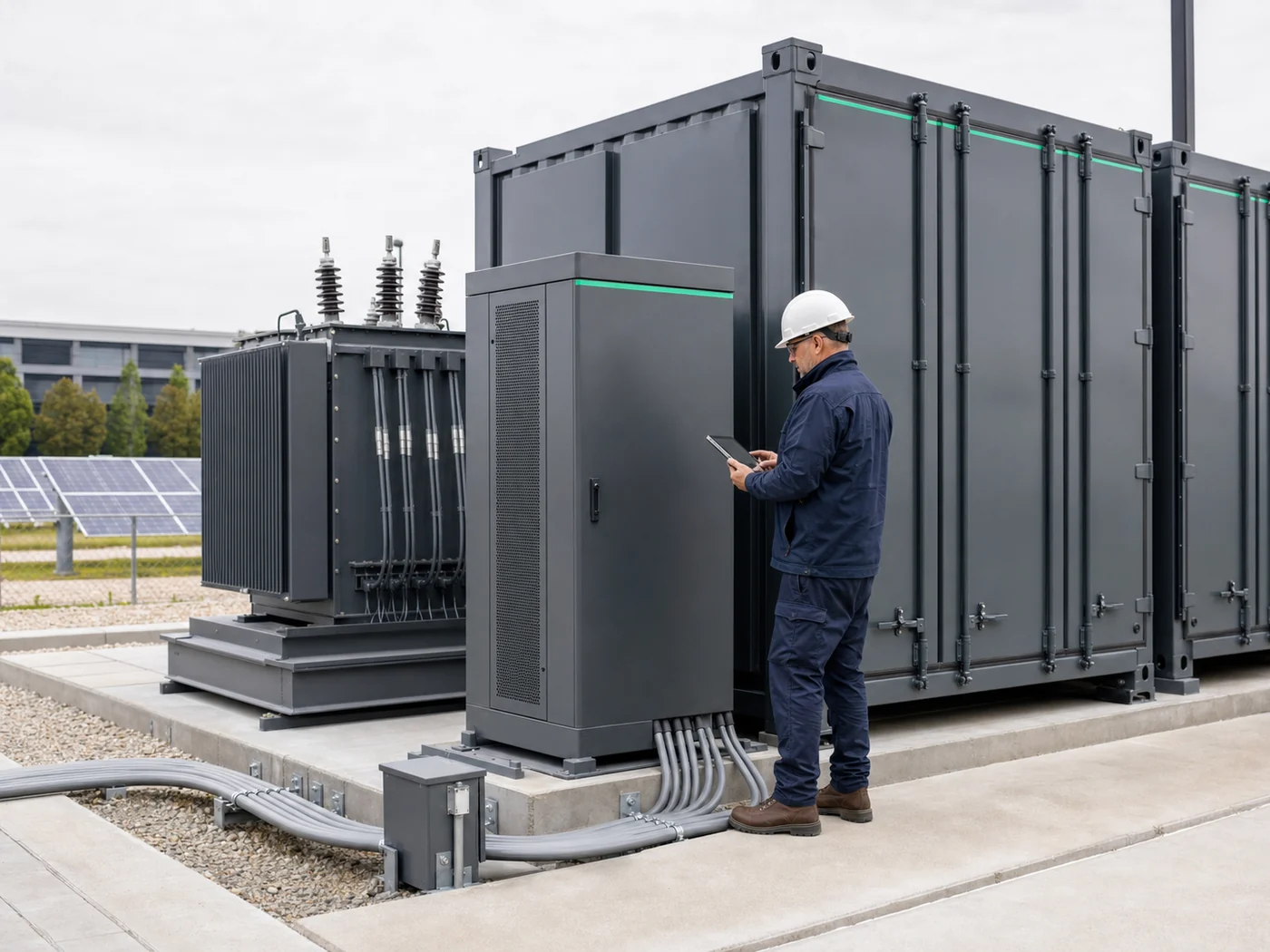
Site survey
Collect the site data before requesting a C&I ESS quotation.
Load profile, grid conditions, PV generation, critical loads, ambient range, footprint and access determine the credible system scope.
A C&I ESS quotation is only as reliable as the site data behind it. Before asking for a cabinet or container price, buyers should collect load profile, backup target, grid phase, PV capacity, installation space, temperature, cable route and delivery access.
This checklist supports outdoor cabinet, BESS container and PCS matching decisions.
Site data controls system choice
A project with the same kWh target can require different PCS power, cooling, enclosure, layout and warranty assumptions depending on the site. Missing data usually produces a broad quote that changes later.
Survey checklist
| Check item | What to request | Why it matters |
|---|---|---|
| Load profile | Peak demand, daily energy use, critical loads and backup duration. | Controls kW/kWh sizing. |
| Grid data | Voltage, phase, transformer capacity, export limits and local rules. | Controls PCS and protection design. |
| PV data | PV capacity, inverter type and operating goal. | Defines charging and self-consumption behavior. |
| Site space | Indoor/outdoor placement, footprint, wall clearance and foundation. | Determines cabinet or container fit. |
| Environment | Temperature, humidity, dust, altitude and ventilation. | Affects cooling and warranty. |
| Delivery access | Road width, crane access, unloading area and schedule. | Prevents logistics delays. |
Use the data before quotation
After collecting data, compare PCS sizing, cooling and supplier responsibilities before approving the system model.
Why incomplete site data creates bad quotations
When site data is incomplete, suppliers must guess. They may assume a different backup duration, ambient temperature, grid phase, delivery route or PV connection than the real project requires. The result can be a quote that looks clean but changes during technical review.
For peak shaving projects, the load profile and demand charge pattern matter most. For backup projects, critical loads and restart behavior matter. For solar + storage projects, PV capacity, inverter type and self-consumption target matter. For container projects, delivery access and foundation space can become the limiting factor.
A simple survey file can prevent many of these problems. It does not need to be a full engineering package, but it should give enough information for the supplier to recommend cabinet or container type, PCS power, cooling method and document scope.
Survey data to update before final order
Before the final order, update any preliminary numbers. Confirm load, PV capacity, installation location, cable distance, ambient temperature, delivery route and expected commissioning date. Small changes in these fields can affect the recommended system.
Quotation review notes for site data
When a supplier quotation is based on incomplete site data, mark the assumptions clearly. Assumptions about backup load, cable distance, ambient temperature, PV connection and delivery route should not be hidden inside the price. They should be visible so the buyer can update them later.
A site survey does not need to be perfect at the first contact stage. It should be good enough to prevent the wrong system type. Once the project moves closer to purchase, the buyer should replace assumptions with measured or confirmed data.
| Quote item | Question to ask | Risk if unclear |
|---|---|---|
| Included scope | Which battery, PCS, EMS, cooling, fire and document items are included? | The buyer may compare a complete system with a partial supply. |
| Responsibility | Who supports setup, troubleshooting, spare parts and warranty claims? | Problems can move between supplier, integrator and installer. |
| Evidence timing | Which documents are available before deposit, before shipment and after commissioning? | Important evidence may arrive too late to influence the purchase decision. |
FAQ
Can I request a quote without site data?
Yes, but it will be less reliable and may change after technical review.
What is the minimum data?
Application, target kWh, power rating, grid phase, installation country and placement.
Why does delivery access matter?
Containers and heavy cabinets need unloading space, lifting points and route planning.
Should PV data be included?
Yes, when solar charging or self-consumption is part of the project.
Who should complete the survey?
Usually the buyer, EPC or installer gathers data, then the supplier reviews it.
Model-driven site survey
Survey the site against the actual enclosure and lifting load.
Use the selected model envelope as the starting point, then add service clearance, fire interfaces, cable bends, crane access and foundation design loads.
| Starting platform | Base enclosure | Approx. weight | Survey emphasis |
|---|---|---|---|
| 105/233 or 125/261.2 cabinet | 1000 × 1400 × 2415 mm | ≈2.7 t | 400 V connection and service access |
| 250/522.5 cabinet | 1940 × 1504 × 2555 mm | ≈5.4 t | Dual-PCS cabinet access and cable route |
| 1.25/3.354 container | 6058 × 2600 × 2896 mm | ≈35 t | MV/PCS step-up and crane plan |
| 1.725 or 2.5 MW / 5.016 MWh | 6500 × 2700 × 2950 mm | ≈44 t | MV boundary, turning radius and foundation |
| 219.24 kWh DC cabinet | 1350 × 1400 × 2665 mm | ≈4.2 t | UPS DC cable and redundancy layout |
Related buyer guides
Continue with the next engineering decision.
Use the guide that matches the open sizing, electrical, safety or quotation question.
Load profile for a BESS quotation
Prepare interval demand, tariffs, PV, generators, critical loads and operating schedules.
Read guidePeak shaving battery sizing
Translate interval load data, target demand and peak duration into kW and kWh.
Read guideCommercial battery storage cost
Separate battery, PCS, enclosure, electrical BOS, delivery and commissioning cost drivers.
Read guideContinue the project review
Connect the next decision.
Use the related page that matches the next equipment, engineering or evidence question.
Bring the site data. Leave with a clearer BESS scope.
Share the load profile, grid voltage, target kW and kWh, installation country, ambient conditions and expected schedule.