
Key takeaways
- Use at least twelve months of interval data when demand charges and seasons matter.
- PCS power follows the maximum required shave; battery energy follows the area above the target setpoint.
- Reserve SOC, charging limits and forecast error need explicit margins in the operating model.
Decision framework
Use this table to align the technical question before comparing equipment or supplier proposals.
| Input | How it affects sizing | Minimum useful evidence |
|---|---|---|
| Interval load | Defines peak magnitude, shape, frequency and duration | 12 months of 15-minute kW data |
| Grid target | Sets the load threshold the BESS must defend | Contract capacity or proposed demand limit |
| Tariff | Determines which peaks create economic value | Demand charge rules, seasons and time windows |
| Charging window | Limits how quickly SOC can be restored | Off-peak capacity, PV surplus and schedule |
| Reserve policy | Reduces energy available for peak shaving | Backup SOC and outage requirement |
Convert the load curve into a duty cycle
Choose a candidate grid setpoint and calculate the load above that setpoint for every interval in the measured load profile. The highest difference indicates the required discharge power. The accumulated energy above the line indicates the discharge energy needed during each event. Repeat the calculation across the year rather than sizing from one monthly bill peak.
For a first estimate, required battery energy equals the sum of shaved kW multiplied by interval duration, then adjusted for conversion losses, usable SOC and margin. Final modeling should use the actual dispatch time step and equipment constraints.
Peak shaving calculation: a worked screening example
Use P_shave(t) = max(P_load(t) - P_grid,target, 0) for each interval. Event energy at the AC point of connection is E_AC = sum(P_shave x interval duration). A screening estimate of nominal battery energy is E_nominal = E_AC / (eta_AC x DeltaSOC_shave), where the SOC window excludes any protected reserve.
For a hypothetical 15-minute event with site loads of 420 kW, 460 kW and 440 kW against a 350 kW grid target, the required shave is 70 kW, 110 kW and 90 kW. The screening PCS requirement is therefore at least 110 kW before project derating, overload duration and reactive-power obligations are checked.
The event requires 67.5 kWh at the AC point: (70 + 110 + 90) x 0.25 h. If the screening assumptions are 92% AC-path efficiency and a 60% SOC window available to peak shaving, nominal energy is approximately 67.5 / (0.92 x 0.60) = 122.3 kWh, before temperature, degradation, availability and design margin are applied.
This is a worked screening example, not a product recommendation or savings forecast. Replace every assumed value with the site’s complete interval data, supplier efficiency curves, approved SOC policy and operating constraints, then test the worst repeated event and recharge window.
Size power and energy separately
A short motor or process peak can require high PCS power but little energy. A long afternoon plateau can require modest power and much more energy. Treating both projects as the same kWh system produces weak results.
Check PCS continuous rating, overload duration and reactive-power obligations. If the PCS must also support voltage, power factor or backup transfer, those functions may reduce the power available for peak shaving.
Cabinet or container for peak shaving?
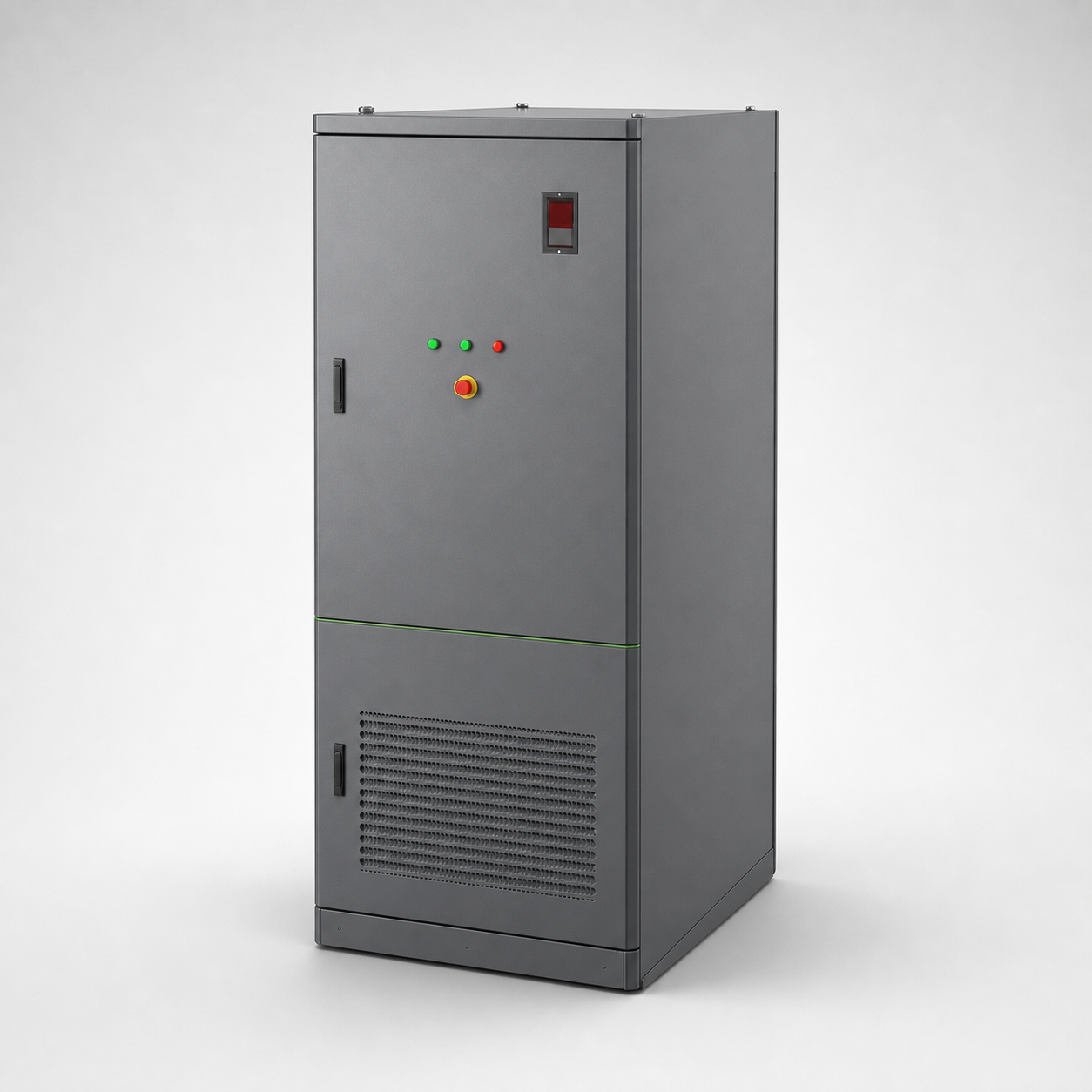
The screening result also points to the equipment format. When the required shave is in the range of roughly one hundred to a few hundred kW, documented outdoor cabinets such as the 105 kW / 233 kWh, 125 kW / 261.2 kWh and 250 kW / 522.5 kWh platforms are the usual starting point. Combining several cabinets is only appropriate when the supplier confirms the parallel architecture, controls and protection. When the peak shaving duty moves into the megawatt range, battery containers such as the documented 1.25 MW / 3.354 MWh, 1.725 MW / 5.016 MWh and 2.5 MW / 5.016 MWh systems become the practical format. Compare the trade-offs in the cabinet vs container BESS guide and the 20ft and 40ft BESS container checklist.
Test charging and reserve constraints
A battery that shaves the morning peak may not have time to recharge before the afternoon peak. Define the peak shaving SOC policy separately from any protected backup reserve, then model charger or PCS limits, import headroom, PV surplus and the site operating schedule. Reserve energy must remain protected unless the approved operating policy explicitly allows its use.
For a grid-setpoint control mode, the EMS should measure demand at the agreed point of connection, discharge above the target plus deadband, charge only when headroom exists, and enforce SOC, power and ramp limits. Forecast error, meter latency and command response should be included in performance testing so the system does not chatter between charge and discharge.
Measure the result after commissioning
Acceptance should confirm meter location, setpoint logic, sampling interval, response time, SOC limits and data export. After commissioning, compare baseline peaks, controlled grid demand, battery power and SOC. This evidence is required to tune the strategy and verify economic performance.
Project requirements, local codes and site conditions take precedence over this general buyer guide. Final system design should be reviewed by qualified project professionals.
Starting configurations
Compare documented platforms.
Use these configurations for screening, then confirm usable energy, electrical boundary and responsibility scope for the site.
105 kW / 233 kWh Cabinet
Compact 400 V AC cabinet platform for distributed C&I sites.
View product →125 kW / 261.2 kWh Cabinet
Two-hour-class 400 V cabinet for solar, peak shaving and backup duty.
View product →250 kW / 522.5 kWh Cabinet
Higher-power cabinet with dual battery strings and dual PCS architecture.
View product →Buyer questions
Frequently asked questions
How much battery capacity is needed for peak shaving?
It depends on the energy above the target grid setpoint, event duration, losses, usable SOC and reserve policy. Interval load data is required.
Is PCS kW or battery kWh more important?
Both are required. PCS kW limits instantaneous peak reduction; usable battery kWh limits how long the reduction can continue.
Can monthly electricity bills size a peak shaving BESS?
Bills are useful for screening but usually do not show peak shape and duration. Use interval meter data for engineering.
Can PV charge the peak shaving battery?
Yes, when sufficient surplus exists at the right time. The model should include PV variability, export limits and the next expected peak.
Match the requirement to a documented configuration.
Use measured site data, a clear electrical boundary and a shared responsibility matrix to request a comparable proposal.