
Power and energy
100 kW vs 100 kWh Battery Storage: Power, Energy and Duration
kW tells you how fast a BESS can charge or discharge. kWh tells you how much energy it stores. A quotation needs both—and a clear usable-energy basis.
The short answer
A 100 kW battery storage system is defined by power: it can deliver or absorb up to the approved 100 kW PCS duty. A 100 kWh battery is defined by energy: it stores 100 kilowatt-hours at the stated rating basis. If a system is both 100 kW and 100 kWh, its simple nameplate energy-to-power ratio is one hour. That is not automatically one full hour of usable AC output because SOC limits, conversion losses, auxiliary loads, temperature, ageing allowance and reserve can reduce deliverable energy.
Core distinction
kW is power; kWh is energy
Power is the rate at which energy moves. In a BESS, the PCS rating usually sets the continuous AC charge or discharge power, subject to voltage, current, temperature, reactive-power and overload limits. Energy is the stored quantity available across the approved battery operating window.
A useful analogy is water flow. kW is similar to flow rate; kWh is similar to the amount held in a tank. A large tank with a small outlet can run for a long time at modest power. A small tank with a large outlet may deliver high power briefly. Neither number can replace the other.
| Rating | What it answers | Main equipment driver | Project evidence |
|---|---|---|---|
| kW | How much power can the system deliver or absorb at one time? | PCS, current, switchgear, transformer, cables and thermal duty | PCS datasheet, SLD, load profile, overload and reactive-power requirements |
| kWh | How much energy can the battery store or deliver over time? | Cell, module, rack/string count, SOC window and degradation basis | Battery datasheet, operating window, warranty and usable-energy definition |
| Hours | How long can the required power be sustained? | Relationship between usable energy and required power | Dispatch profile, reserve, losses, ambient conditions and end-of-life requirement |
| C-rate | How quickly is battery capacity charged or discharged? | Cells, busbars, DC collection, cooling and warranty duty | Approved charge/discharge current and cycle conditions |
Duration calculation
Calculate the nameplate ratio—then correct it
The first screening calculation is simple: divide rated energy by rated power. A 100 kWh battery paired with a 100 kW PCS has a one-hour nameplate ratio. A 200 kWh battery paired with the same 100 kW PCS has a two-hour ratio. But procurement should specify usable AC energy at the required operating conditions, not rely on the ratio alone.
Suppose reserve SOC, permitted depth of discharge, conversion losses and auxiliaries leave 85 kWh available at the AC boundary. At a constant 100 kW output, the usable duration is about 0.85 hours, or 51 minutes. That example is not a universal derating factor; each quotation must state its own assumptions.
Common mistakes
Do not use 100 kW and 100 kWh interchangeably
A 100 kW BESS may store far more than 100 kWh
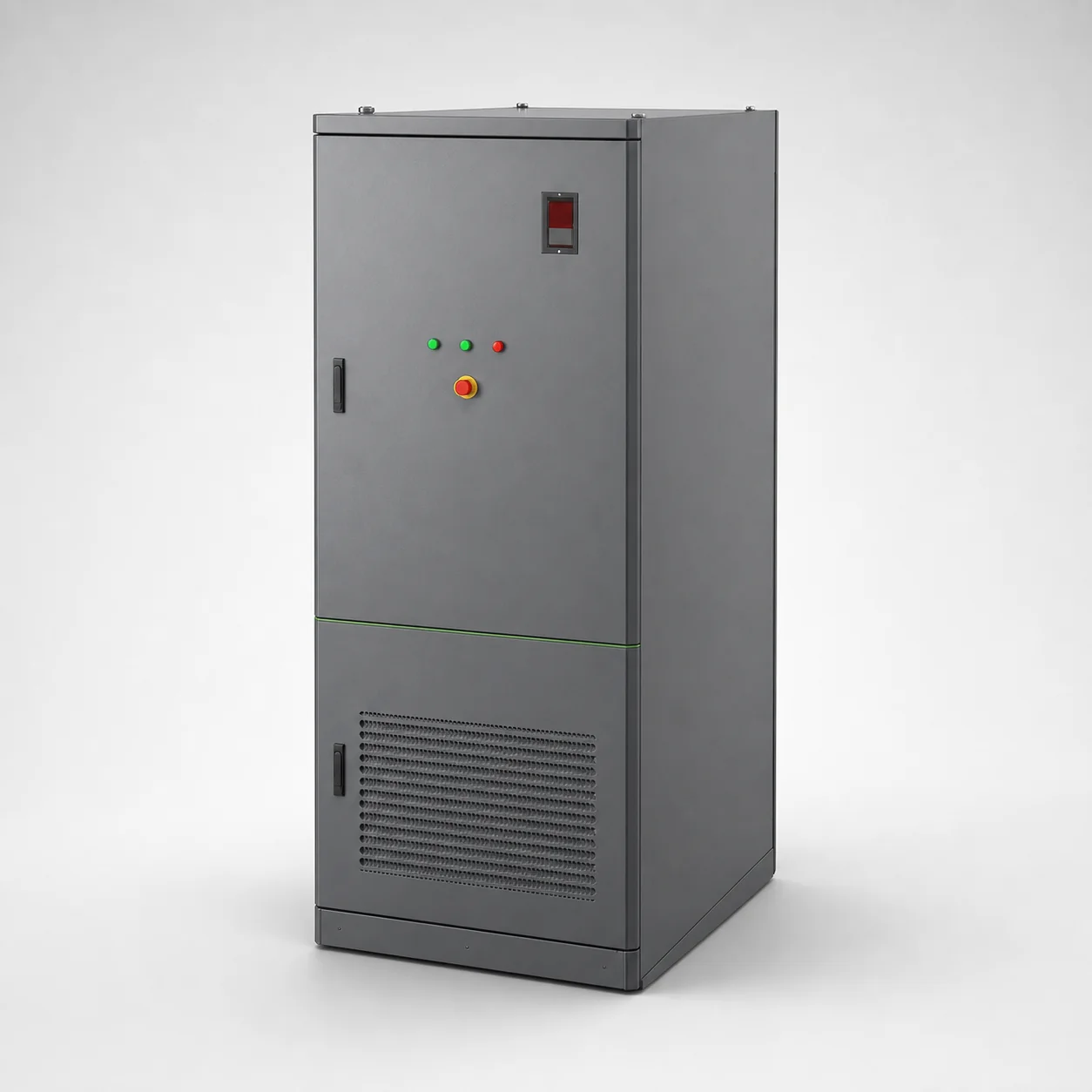
The documented 105 kW cabinet stores 233 kWh of rated energy, giving a nameplate ratio of about 2.22 hours. Describing it only as a “100 kW battery” hides the energy and duration; describing it only as a “233 kWh cabinet” hides the PCS power and current.
A 100 kWh battery does not prove 100 kW output
The battery may be paired with a smaller PCS, or its cell current, DC voltage window, thermal design and warranty may limit the allowed discharge rate. Ask for continuous and overload power at the relevant ambient temperature and state of charge.
Rated energy is not guaranteed usable AC energy
Rated DC energy is a product characteristic. Usable AC energy depends on SOC limits, DC and AC losses, auxiliary consumption, temperature, degradation, reserve and the guarantee point. Quotations should label each value so buyers do not compare different boundaries.
Documented cabinet examples
See how kW and kWh work together
All three examples are approximately two-hour-class by rated values, even though their kW and kWh numbers differ. The 250 kW system delivers more power and stores more energy, while the ratio remains similar. Use the cabinet vs container BESS guide when the required block moves toward centralized megawatt-scale equipment.
Application sizing
Let the operating objective determine which number comes first
Start with kW reduction
Measure the target demand limit and peak shape. The difference between baseline demand and the target defines PCS power; peak duration defines usable kWh.
Start with critical loads
Sum the kW of loads that must remain online, then model their operating sequence and required autonomy to calculate usable energy and reserve.
Start with time-series surplus
PV surplus determines the charging opportunity in kW and kWh. The evening load and export rules determine discharge power and energy.
Start with charger coincidence
Charger power and utilization establish short peaks; transformer or grid limits determine the storage power needed to stay below the site threshold.
For mixed objectives, define a priority order. A battery reserved for backup cannot use the same energy simultaneously for daily peak shaving unless the SOC policy and operating risk are explicitly accepted.
Power-to-energy relationship
C-rate connects battery energy to discharge speed
A one-hour discharge corresponds approximately to 1C; a two-hour discharge corresponds approximately to 0.5C. The relationship is useful for screening but does not override the approved current, voltage, temperature or warranty limits. A high-power PCS cannot force a battery to deliver a C-rate that the cells, racks, DC collection and cooling system do not support.
At project level, also check reactive power. A PCS operating at non-unity power factor may have less active kW available, depending on its kVA rating and control requirements. This is another reason to define power at the point of connection rather than relying on a headline number.
Quotation inputs
Write both ratings into the RFQ
State required continuous AC power in kW, required usable AC energy in kWh, duration at the specified power, point-of-connection voltage, operating mode, reserve SOC, ambient range, end-of-life basis and acceptance test. Attach interval load, PV or charger data so the supplier can show how the selected configuration meets the duty.
Do not request “a 100 kWh cabinet” without a power target. Do not request “a 100 kW system” without a duration or usable-energy requirement. Use the industrial BESS quotation scope and load-profile guide to give each supplier the same input boundary.
The calculations on this page are screening examples. Final system guarantees must be stated in approved project documents and verified at the agreed electrical boundary.
Buyer questions
Frequently asked questions
Is a 100 kW battery the same as a 100 kWh battery?
No. 100 kW describes the power conversion rate, while 100 kWh describes stored energy. A complete BESS specification needs both values.
How long can a 100 kWh battery run at 100 kW?
The nameplate ratio is one hour, but actual usable AC duration is shorter unless the 100 kWh value already accounts for SOC limits, efficiency, auxiliary loads, temperature and reserve.
Can a 100 kWh battery deliver more than 100 kW?
Only if the cell, rack, DC collection and PCS ratings support the required C-rate, current, voltage and thermal duty. Energy capacity alone does not prove output power.
Why does a 105 kW / 233 kWh cabinet show about 2.22 hours?
Dividing 233 kWh of rated energy by 105 kW of rated power gives about 2.22 hours. Guaranteed usable duration still depends on the approved project operating window and losses.
Which value should be specified first for peak shaving?
Use the measured load profile to determine the kW reduction target and how long the peak lasts. Those two results establish the starting PCS power and usable energy requirement.
Specify power and usable energy together.
A clear kW, kWh, duration and boundary definition makes supplier quotations comparable.