
Key takeaways
- Calculate duration from usable AC energy divided by continuous AC power.
- Match duration to the actual peak window, backup requirement or dispatch schedule.
- State reserve SOC, temperature and end-of-life assumptions before accepting a duration claim.
Decision framework
Use this table to align the technical question before comparing equipment or supplier proposals.
| Decision point | 2-hour system | 4-hour system |
|---|---|---|
| Typical objective | Higher power over a shorter peak or dispatch window | Longer energy shifting, backup or renewable firming window |
| Energy-to-power ratio | About 2 kWh of usable energy per 1 kW | About 4 kWh of usable energy per 1 kW |
| PCS share of budget | Generally more power-conversion capacity per unit of energy | Generally more battery energy per unit of PCS power |
| Control priority | Peak limit, ramp rate and rapid dispatch | Energy budget, forecast and sustained dispatch |
| Main sizing risk | Peak lasts longer than expected | Energy is oversized while available charge opportunity is limited |
Calculate the duration that matters
The simplest screening equation is usable AC energy divided by continuous AC discharge power. A 5 MWh nameplate battery paired with a 2.5 MW PCS may look like a two-hour system, but final usable duration depends on SOC limits, auxiliary consumption, conversion efficiency, temperature and degradation assumptions.
Ask whether the stated duration applies at beginning of life or end of warranty, at what ambient condition, and with what reserve. Those details turn a marketing ratio into an engineering requirement.
Use the load window, not a preferred ratio
For peak shaving, measure how long the facility remains above the proposed grid setpoint. A short, sharp peak may favor a power-led system. A broad afternoon demand plateau may need more energy. For backup, sum the critical loads and define how their demand changes during an outage rather than multiplying the facility peak by an arbitrary number of hours.
Renewable shifting adds a second question: is enough surplus energy available to charge the battery regularly? A four-hour system is not automatically better if the site rarely produces or purchases enough low-cost energy to fill it.
Model reserve, losses and degradation
A dispatch model should include minimum and maximum SOC, round-trip losses, HVAC and auxiliary loads, seasonal derating, downtime assumptions and capacity fade. Backup reserve reduces the energy available for daily arbitrage or peak shaving; that tradeoff should be visible in the operating policy.
Run at least three scenarios: typical day, worst credible peak day and constrained charging day. If the same duration remains useful across all three, the selection is more robust.
Use product ratios as starting points
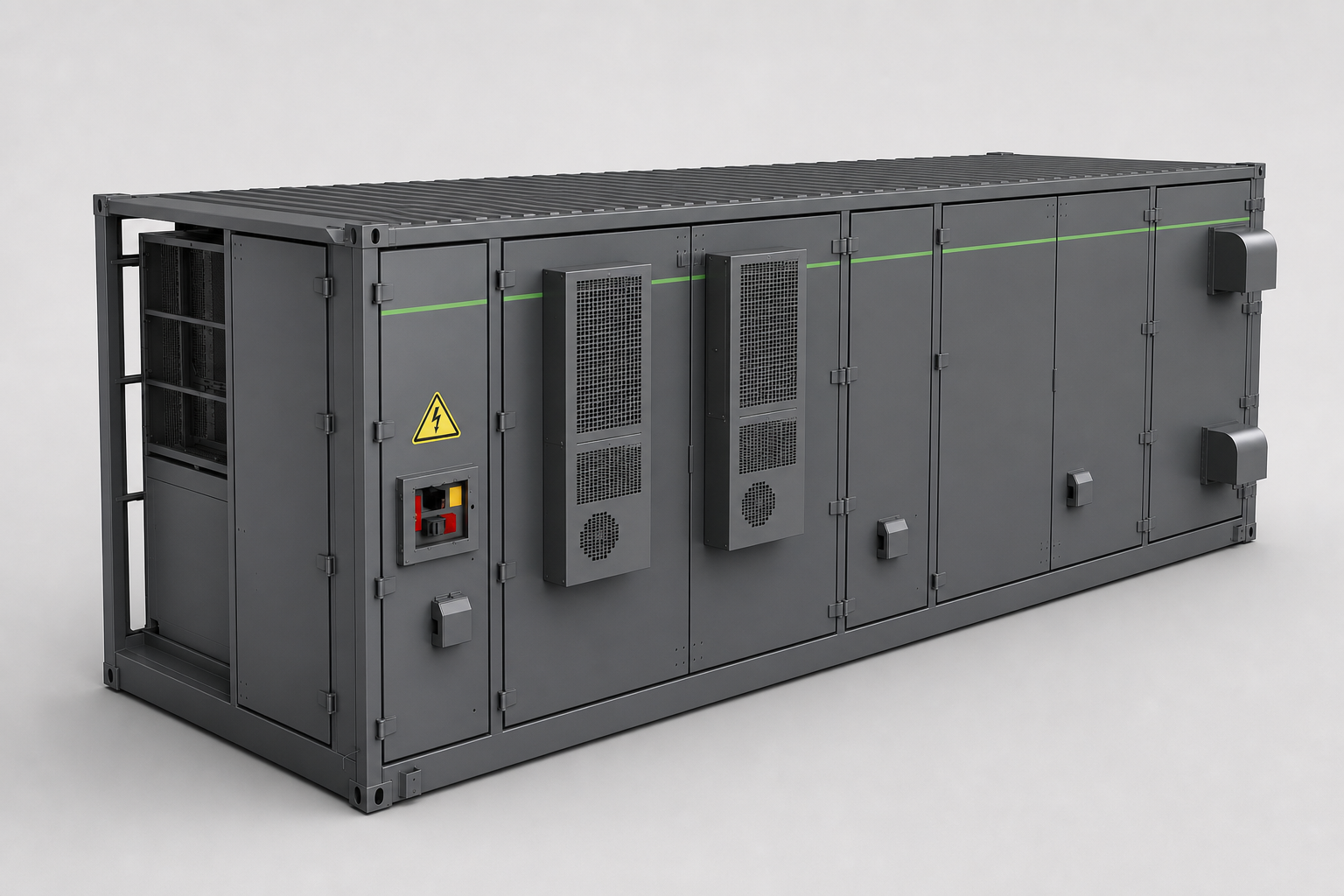
Documented platforms can accelerate screening, but the project requirement still comes first. The 2.5 MW / 5.016 MWh platform is a high-power two-hour-class starting point, while the 1.725 MW / 5.016 MWh configuration provides a longer energy-led window. Final usable duration is confirmed during project engineering.
Project requirements, local codes and site conditions take precedence over this general buyer guide. Final system design should be reviewed by qualified project professionals.
Starting configurations
Compare documented platforms.
Use these configurations for screening, then confirm usable energy, electrical boundary and responsibility scope for the site.
2.5 MW / 5.016 MWh Container
High-power two-hour-class container starting point for utility-scale C&I duty.
View product →1.725 MW / 5.016 MWh Container
Three-hour-class container starting point for longer dispatch windows.
View product →1.25 MW / 3.354 MWh Container
Energy-led container platform with a 690 V PCS stage and project step-up interface.
View product →Buyer questions
Frequently asked questions
How is BESS duration calculated?
For screening, divide usable AC energy in kWh by continuous AC power in kW. Final duration must include SOC limits, losses, auxiliaries, temperature and degradation.
Is a 4-hour battery always better than a 2-hour battery?
No. The better duration is the one that matches the load, tariff, renewable surplus, backup target and charging opportunity.
Can one battery provide peak shaving and backup?
Yes, but the EMS must reserve sufficient SOC for backup. Reserved energy is not available for normal peak-shaving dispatch.
Why is nameplate energy different from usable energy?
Operating SOC limits, conversion losses, auxiliary loads, temperature and degradation reduce the energy available at the AC interface.
Match the requirement to a documented configuration.
Use measured site data, a clear electrical boundary and a shared responsibility matrix to request a comparable proposal.