
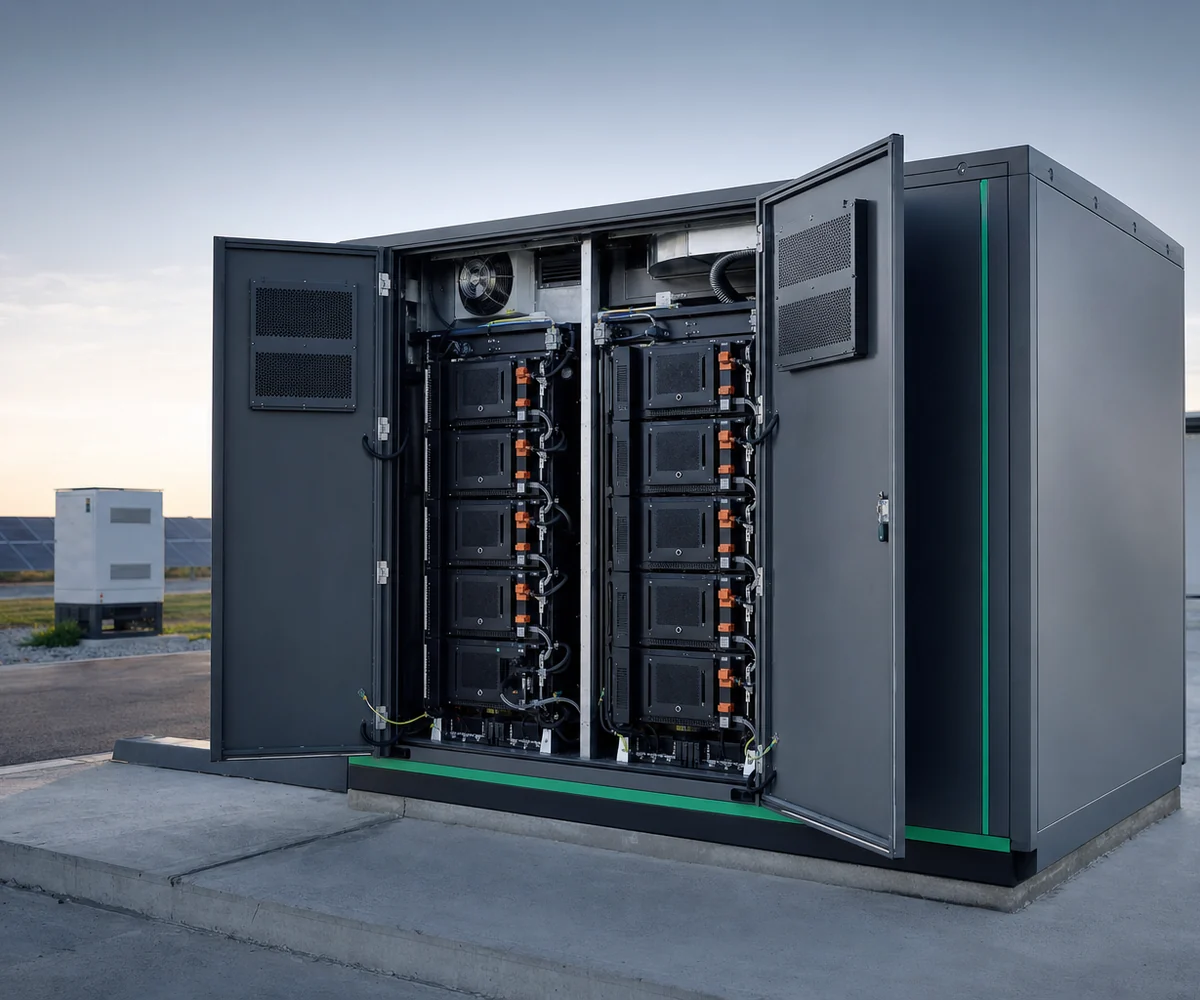
Thermal design
Review outdoor ESS cooling before the site exposes weak assumptions.
Match airflow, HVAC capacity, condensation control, filters, alarms and maintenance access to the installation environment.
Cooling design affects outdoor ESS reliability, alarms and warranty. A cabinet that looks acceptable by capacity can still perform poorly if airflow, HVAC access, condensation control and maintenance records are weak.
Use this checklist before approving an outdoor battery storage cabinet or comparing air-cooled and liquid-cooled C&I storage options.
Cooling is a service issue, not only a design feature
Filters, fans, HVAC units and access panels must be reachable by the maintenance team. If the cabinet needs frequent service but the site does not allow access, the warranty and operating plan can become unrealistic.
Cooling checklist
| Check item | What to request | Why it matters |
|---|---|---|
| Ambient range | Minimum and maximum operating temperature. | Defines site fit. |
| Airflow path | Intake, exhaust, blocked zones and clearance requirements. | Prevents hot spots. |
| HVAC access | Filter replacement, service clearance and spare parts. | Controls maintenance practicality. |
| Condensation | Drainage, humidity control and anti-condensation notes. | Reduces water-related risk. |
| Alarms | Temperature alarms, fan/HVAC fault and maintenance logs. | Provides evidence for warranty and troubleshooting. |
Connect cooling with project evidence
Cooling should be reviewed with site temperature data, supplier qualification and FAT records.
Cooling design should match the installation environment
An outdoor ESS cabinet installed in a mild climate has different cooling needs from a cabinet installed near a dusty factory, coastal humidity or high summer temperature. The buyer should not accept a generic cooling statement without checking the real operating environment.
Service access matters as much as cooling capacity. Filters, fans, HVAC units and drainage points need to be reachable. If maintenance requires moving other equipment or shutting down too much of the system, the plan may not be practical for the site team.
Cooling evidence should be connected with warranty terms. If the supplier requires periodic filter cleaning or alarm logs, the buyer should know how those records are collected and who is responsible for them after commissioning.
Cooling questions before order confirmation
Ask for the design ambient temperature, airflow path, clearance requirements, HVAC model or fan specification, filter replacement interval, condensation handling method and temperature alarm logic. These questions are simple, but they reveal whether the cabinet was designed for real outdoor service.
Quotation review notes for cooling scope
Cooling scope should be visible in the quotation. Ask whether fans, HVAC units, filters, temperature sensors, alarm logic, condensation handling and maintenance access are included. If cooling appears only as a short phrase, the buyer should request a clearer description.
Maintenance cost should also be considered. Outdoor filters, HVAC service and alarm logs are not decorative details; they are part of the operating plan. A cabinet that is hard to maintain may create warranty and uptime problems later.
| Quote item | Question to ask | Risk if unclear |
|---|---|---|
| Included scope | Which battery, PCS, EMS, cooling, fire and document items are included? | The buyer may compare a complete system with a partial supply. |
| Responsibility | Who supports setup, troubleshooting, spare parts and warranty claims? | Problems can move between supplier, integrator and installer. |
| Evidence timing | Which documents are available before deposit, before shipment and after commissioning? | Important evidence may arrive too late to influence the purchase decision. |
FAQ
Is air cooling enough for every outdoor cabinet?
No. It depends on ambient temperature, cabinet load, airflow and service requirements.
Why does condensation matter?
Outdoor cabinets can see humidity and temperature swings that create water risk.
What evidence should I request?
Cooling layout, HVAC model, filter access, alarm list and maintenance interval.
Can poor cooling affect warranty?
Yes. Suppliers may require maintenance records and operating temperature evidence.
Should cooling be checked before price comparison?
Yes, because cooling scope changes real project cost.
Verified thermal basis
The documented portfolio uses intelligent liquid cooling.
Liquid cooling does not remove the need for ambient, condensation, auxiliary-power and maintenance checks. Confirm heat-rejection clearance and derating for the project location.
| Platform | Documented operating range | Humidity basis | Enclosure basis |
|---|---|---|---|
| C&I cabinets | −20 °C to 55 °C | 0–95%, non-condensing | IP54 / C3 |
| Container BESS | −20 °C to 55 °C | 0–95%, non-condensing | IP54 / C3 |
| 100/233 hybrid cabinet | −20 °C to 55 °C | 0–95%, non-condensing | IP54 / C3 |
| 219.24 kWh sodium-ion DC | −20 °C to 55 °C | 0–95%, non-condensing | IP54 / C3 |
Related buyer guides
Continue with the next engineering decision.
Use the guide that matches the open sizing, electrical, safety or quotation question.
BESS fire protection documents
Check design basis, detection, suppression, alarms, emergency stop and FAT evidence.
Read guideCommercial battery storage cost
Separate battery, PCS, enclosure, electrical BOS, delivery and commissioning cost drivers.
Read guideLoad profile for a BESS quotation
Prepare interval demand, tariffs, PV, generators, critical loads and operating schedules.
Read guideContinue the project review
Connect the next decision.
Use the related page that matches the next equipment, engineering or evidence question.
Bring the site data. Leave with a clearer BESS scope.
Share the load profile, grid voltage, target kW and kWh, installation country, ambient conditions and expected schedule.