
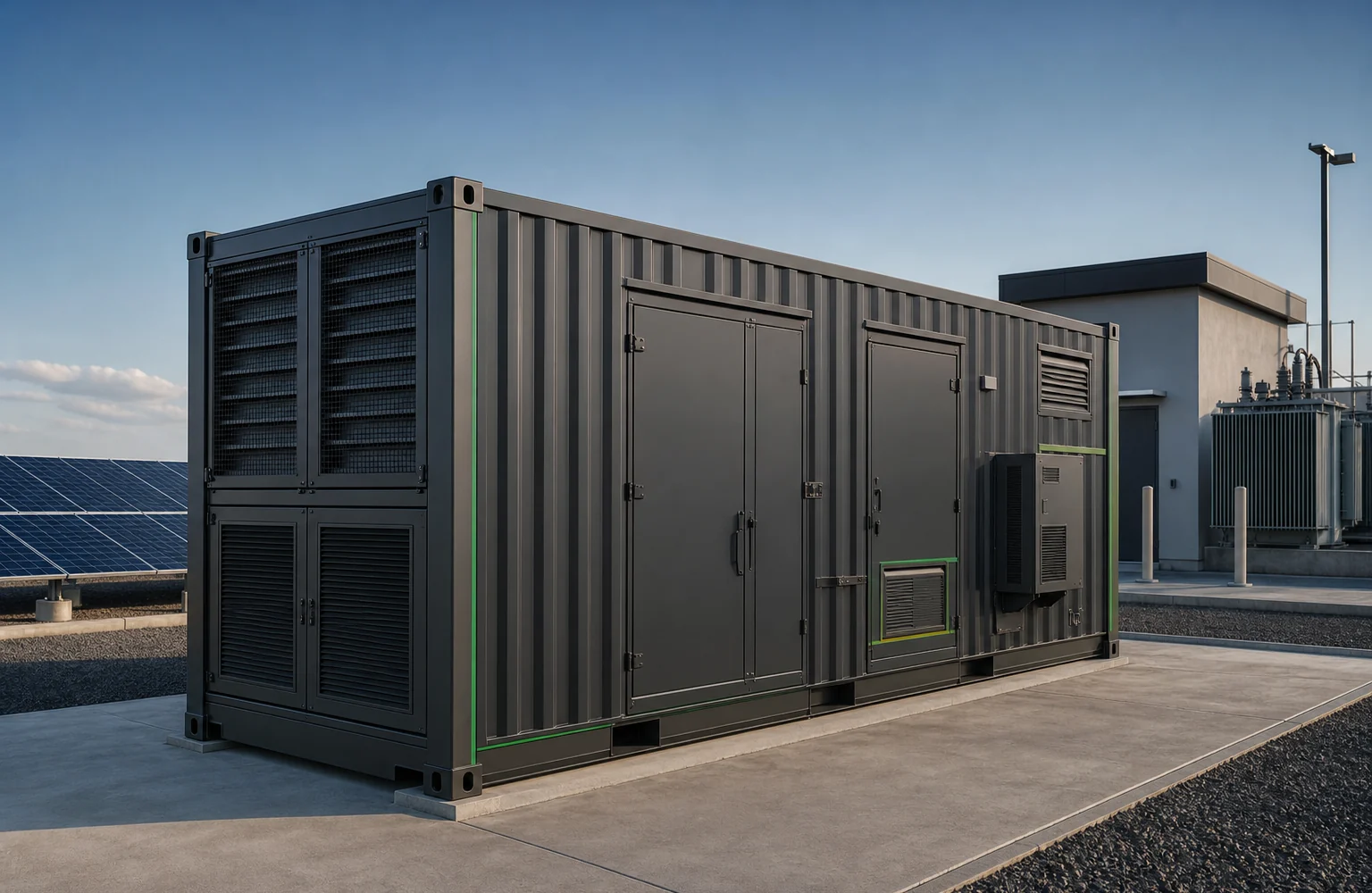
Containerized BESS
Resolve 20ft and 40ft BESS container scope before layout freeze.
Compare power target, energy capacity, HVAC, fire protection, service zones, shipping limits and site handover evidence.
A 20ft or 40ft BESS container is a larger project package than a cabinet ESS. It may include battery racks, PCS, EMS, HVAC, fire safety equipment, cable routing, lighting, service access and site handover records.
This checklist helps buyers compare containerized systems before quotation. If the project is still early, start with the site survey checklist.
Choose container size by site scope
A 20ft container may fit smaller C&I projects, staged deployment or limited delivery space. A 40ft container can provide more capacity and service space, but it needs stronger planning for foundation, lifting, HVAC and commissioning.
Container checklist
| Check item | What to request | Why it matters |
|---|---|---|
| Layout | Rack layout, PCS/EMS position, HVAC location, doors and service aisle. | Confirms that the system can be operated and maintained. |
| PCS scope | Power rating, overload, grid mode, transformer assumptions and EMS boundary. | Prevents confusion between battery capacity and site power. |
| HVAC | Airflow, cooling capacity, filter access, temperature range and condensation handling. | Protects battery reliability and warranty. |
| Fire safety | Detection, suppression, emergency stop, alarm logic and local documents. | Supports installation approval and risk review. |
| Shipping | Weight, lifting points, dimensions, packing scope and delivery route limits. | Reduces delivery and unloading delays. |
Evidence before shipment
Ask for FAT records that connect the exact container serial number with battery racks, PCS model, EMS version, HVAC equipment and shipment documents. For supplier review, use the supplier qualification checklist.
Layout decisions buyers should not postpone
A BESS container layout should be reviewed before the commercial offer is treated as final. Battery rack spacing, PCS location, HVAC service access, emergency exits, fire system location, cable routing and lighting affect how the container will be installed and maintained. These items are much harder to change after production begins.
A 20ft container may be attractive when site space and delivery access are limited. A 40ft container may be better when the project needs more battery racks, clearer service aisles or a more complete PCS and HVAC arrangement. The correct choice depends on capacity, power, installation site and maintenance plan rather than container length alone.
Ask whether the container is shipped as a complete integrated system or as a partly configured enclosure that still needs significant site work. The answer affects customs documents, commissioning time, warranty boundaries and responsibility when troubleshooting starts.
Handover evidence for container projects
For containerized BESS, handover evidence should include layout drawing, FAT record, PCS model, EMS version, battery rack serial references, HVAC model, fire system documents, packing photos, lifting information and site installation notes. When these files are organized before shipment, commissioning is usually easier to manage.
Quotation review notes for BESS containers
For a container project, the buyer should request a scope split between factory-integrated items and site-installed items. Battery racks, PCS, EMS, HVAC, fire safety, lighting, cable trays, grounding bars and monitoring can be supplied in different ways. The container drawing should match the commercial offer.
Delivery planning should also appear in the quote review. Container weight, lifting point, unloading method, foundation preparation, door opening clearance and cable entry location can all affect site work. A project team should not wait until shipment to discover that the container cannot be unloaded or serviced as planned.
| Quote item | Question to ask | Risk if unclear |
|---|---|---|
| Included scope | Which battery, PCS, EMS, cooling, fire and document items are included? | The buyer may compare a complete system with a partial supply. |
| Responsibility | Who supports setup, troubleshooting, spare parts and warranty claims? | Problems can move between supplier, integrator and installer. |
| Evidence timing | Which documents are available before deposit, before shipment and after commissioning? | Important evidence may arrive too late to influence the purchase decision. |
FAQ
When should I choose a 20ft container?
When capacity, site footprint and delivery access fit a smaller integrated package.
When is a 40ft container better?
When the project needs more capacity, more service space or a more complete PCS/HVAC layout.
What layout drawing should I request?
Battery racks, PCS/EMS area, HVAC, cable route, fire system, doors and service aisle.
Why does HVAC matter?
It controls battery temperature, alarms, maintenance and warranty conditions.
Can StorageCabinetPro review a BESS container quotation?
Yes. Send layout, target kWh, PCS power, site country and project data through Contact.
Verified container reference
Start with the documented container envelope and duty ratio.
The current platforms are approximately 6.1–6.5 m long. Do not assume a generic 20 ft or 40 ft shipping envelope without the approved general arrangement.
| Configuration | Charge/discharge rate | Base enclosure | Approx. weight | Connection basis |
|---|---|---|---|---|
| 1.25 MW / 3.354 MWh | ≤0.33C | 6058 × 2600 × 2896 mm | ≈35 t | 10 kV project side |
| 1.725 MW / 5.016 MWh | ≤0.33C | 6500 × 2700 × 2950 mm | ≈44 t | 10 kV project side |
| 2.5 MW / 5.016 MWh | ≤0.5C | 6500 × 2700 × 2950 mm | ≈44 t | 10 kV project side |
Related buyer guides
Continue with the next engineering decision.
Use the guide that matches the open sizing, electrical, safety or quotation question.
2-hour vs 4-hour battery storage
Compare load shape, usable energy, SOC reserve, cycle duty and project economics.
2h vs 4h BESS400 V vs 690 V BESS
Review current, cable, switchgear, transformer and AC interface implications.
Read guideBESS fire protection documents
Check design basis, detection, suppression, alarms, emergency stop and FAT evidence.
Read guideContinue the project review
Connect the next decision.
Use the related page that matches the next equipment, engineering or evidence question.
Bring the site data. Leave with a clearer BESS scope.
Share the load profile, grid voltage, target kW and kWh, installation country, ambient conditions and expected schedule.