
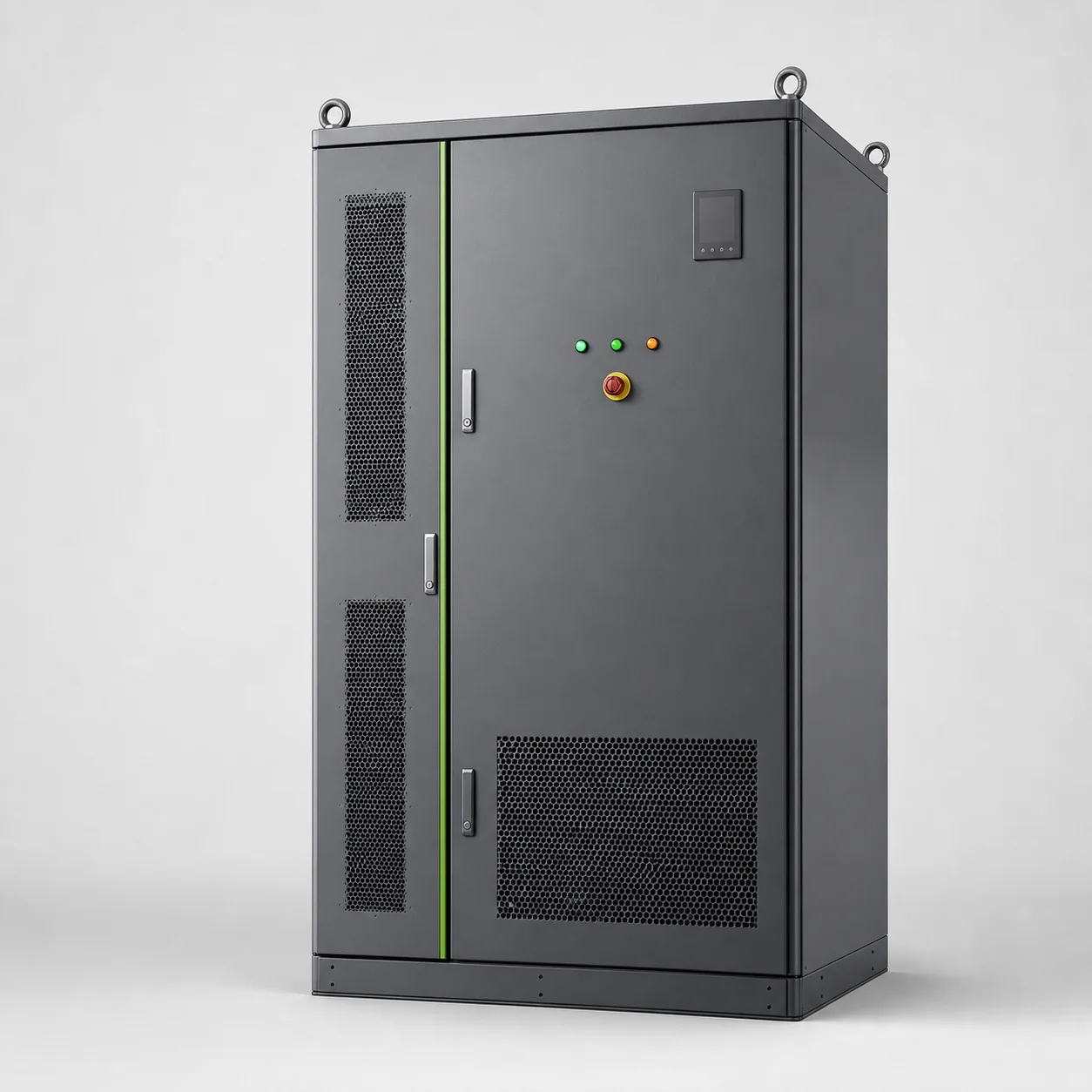
Integrated weak-grid and microgrid cabinet
100 kW / 233 kWh PV-Storage-Diesel SystemPV, storage, transfer and diesel coordination in one platform.
A 100 kW PCS with 233 kWh rated LFP battery energy, 100 kW DCDC/MPPT, 200 kW STS and an interface for an external diesel generator.
Application fit
Start with the operating duty.
This is not a 100 kWh cabinet: 100 kW is the rated PCS output, while 233 kWh is the rated battery energy. The battery, PCS, MPPT/DCDC and STS share a coordinated EMS, while the PV array, external generator, distribution and site protection remain project interfaces.
Open the RFQ input checklistIntegrated architecture
Four layers form the starting platform.
The commercial scope still needs a project responsibility matrix covering every external interface.
PV input
A 100 kW DCDC/MPPT stage connects the PV source to the cabinet DC bus.
Battery storage
A 233 kWh, 832 V nominal LFP string buffers renewable energy and supplies reserve.
AC conversion and transfer
The 100 kW PCS and 200 kW STS coordinate grid-connected and island operation.
Diesel and controls
An external generator interface and EMS implement source priority, restart and protection logic.
Technical specifications
Documented configuration data.
Values are taken from the supplied manufacturer specification. Final purchase, installation and acceptance must use the approved project datasheet, drawings and test documents.
| Group | Parameter | Documented value |
|---|---|---|
| Battery | Cell chemistry and format | LFP, 3.2 V / 280 Ah |
| Battery | Rated energy | 233 kWh |
| Battery | Nominal DC voltage | 832 V |
| Battery | DC voltage window | 650-949 V |
| Battery | String arrangement | 1P260S |
| PCS | Rated AC output | 100 kW |
| PCS | Rated current | 150 A |
| PCS | Permitted grid voltage | 380/400 V, -15% to +15% |
| PCS | Frequency and power factor | 50/60 Hz; 0.99 |
| PCS | Maximum conversion efficiency | 98.5% |
| Hybrid | PV DCDC / MPPT | 100 kW |
| Hybrid | Static transfer switch | 200 kW STS |
| Hybrid | Diesel generation | External generator interface |
| System | Charge/discharge rate | 0.5C |
| System | Base enclosure dimensions | 1400 x 1400 x 2418 mm |
| System | Interface envelope | 1400 x 1520 x 2538 mm |
| System | Approximate weight | 3 t |
| System | Communications | CAN / RS485 / Ethernet / 4G |
| Environment | Altitude | Up to 2000 m |
| Environment | Enclosure | IP54; C3 corrosion protection |
| Environment | Operating temperature | -20 C to 55 C |
| Environment | Relative humidity | 0-95%, non-condensing |
| Thermal | Cooling | Intelligent liquid cooling |
| Safety | Fire suppression | Perfluorohexanone system |
Scope boundary
Separate product from project.
A comparable quotation makes included equipment and external responsibilities explicit.
Starting equipment scope
Documented platform
- 233 kWh LFP battery and BMS
- 100 kW bidirectional PCS
- 100 kW DCDC/MPPT stage
- 200 kW static transfer switch
- EMS source-priority control
- Liquid cooling, fire system and cabinet auxiliaries
Project boundary
Confirm before quotation
- PV module quantity and string design
- External diesel-generator rating and controls
- Grid, generator and load switchboard boundary
- Neutral, grounding and islanding philosophy
- Black-start and load-step test requirements
- Site wiring, civil works and local approvals
Buyer questions
Resolve these points before ordering.
Use the answers to narrow the design; use the final project documents to release the order.
Is this a 100 kWh cabinet energy storage system?
No. The documented configuration is 100 kW / 233 kWh: 100 kW is rated PCS output, while 233 kWh is rated battery energy. Guaranteed usable AC energy requires the approved SOC window, losses, auxiliaries, ambient and ageing assumptions.
Is the diesel generator inside the cabinet?
No. The documented system provides an interface for an external diesel generator. Generator rating, controller protocol, starting sequence, fuel autonomy and switchgear are project inputs.
Can the system run without the grid?
Yes as a project-engineered island system, provided the load schedule, PV behavior, generator interface, grounding, transfer logic, black start and reserve SOC are validated.
Does 100 kW PV mean the array must be exactly 100 kWp?
The DCDC/MPPT rating is 100 kW. Final PV DC sizing depends on module data, string voltage, temperature, oversizing policy and the approved MPPT operating window.
How is source priority configured?
EMS logic can prioritize PV, battery, grid and diesel according to site requirements. The exact modes, thresholds, reserve levels and restart sequence are agreed during engineering.
Buyer engineering guides
Check the assumptions around this configuration.
Connect the product data to measured demand, electrical design, safety evidence and quotation scope.
Compare adjacent configurations
Continue the product review.
Compare power, duration, interface and project boundary before selecting a starting platform.
Product quick RFQ
Match this configuration to the real site.
Send the country, operating target and the first project requirements. The product title and source page are attached automatically.