
High-power two-hour container BESS
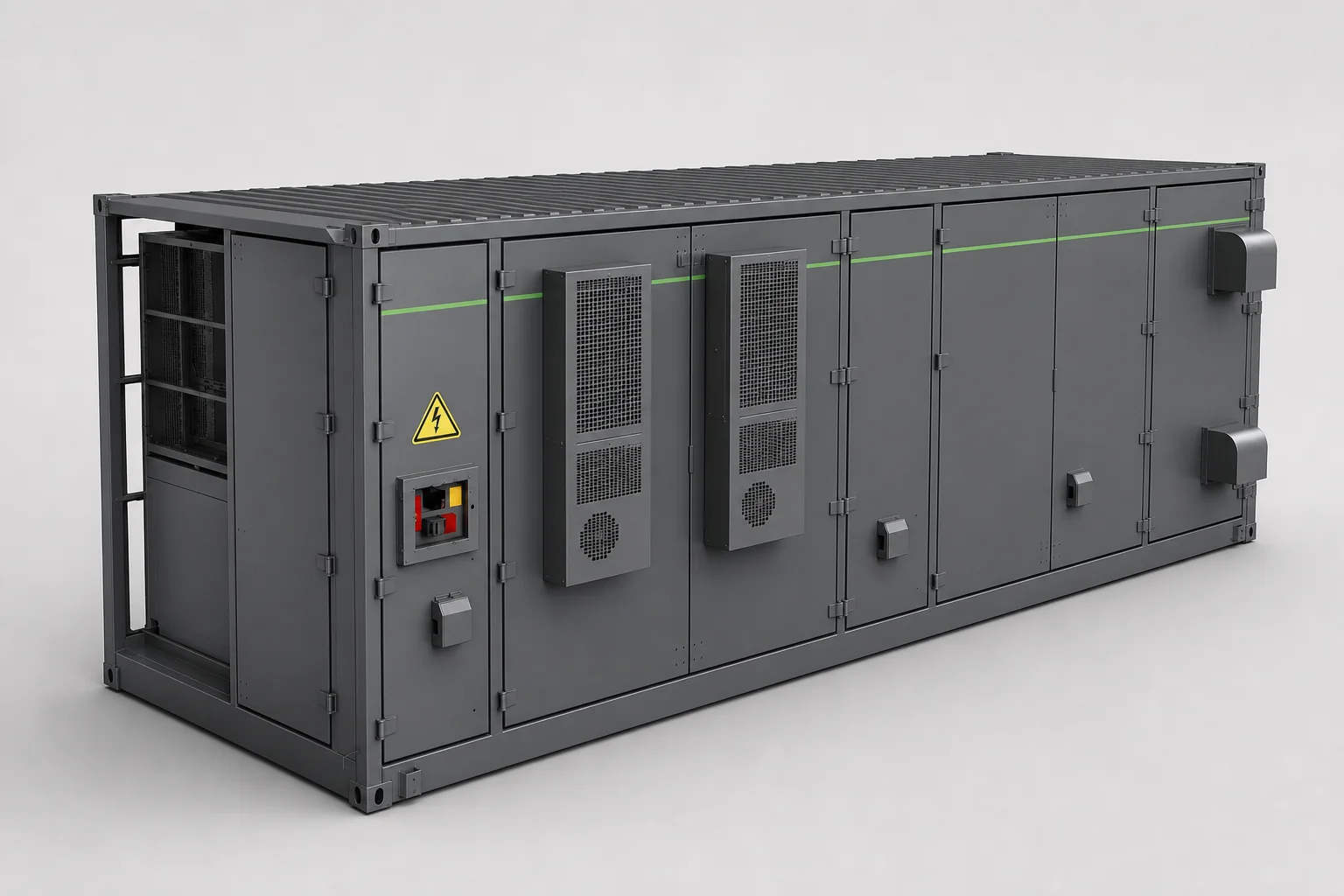
2.5 MW / 5.016 MWh Container BESSThe 5.016 MWh platform configured for higher discharge power.
A 12-string LFP container with a 2.5 MW PCS stage, designed around approximately two-hour rated duty for larger industrial and grid-connected projects.
Application fit
Start with the operating duty.
The 2.5 MW version uses the same twelve-string, 5.016 MWh battery platform as the 1.725 MW configuration but increases PCS power and maximum DC current. It is the higher-power choice when approximately two-hour duty better matches the load or dispatch target.
Open the RFQ input checklistIntegrated architecture
Four layers form the starting platform.
The commercial scope still needs a project responsibility matrix covering every external interface.
Battery strings
Twelve 314 Ah LFP strings provide 5.016 MWh at 1331.2 V nominal DC.
High-power DC collection
The collection system is coordinated for a documented maximum DC current of 2750 A.
2.5 MW PCS stage
A 690 V PCS interface supports the higher-power two-hour-class configuration.
Project integration
EMS, MV step-up, protection, SCADA and site infrastructure are resolved at project level.
Technical specifications
Documented configuration data.
Values are taken from the supplied manufacturer specification. Final purchase, installation and acceptance must use the approved project datasheet, drawings and test documents.
| Group | Parameter | Documented value |
|---|---|---|
| Battery | Cell chemistry and format | LFP, 3.2 V / 314 Ah |
| Battery | Rated energy | 5016 kWh |
| Battery | Nominal DC voltage | 1331.2 V |
| Battery | DC voltage window | 1040-1500 V |
| Battery | String arrangement | 12P416S |
| PCS | Rated AC output | 2500 kW |
| PCS | PCS AC voltage | 690 V |
| PCS | Maximum DC current | 2750 A |
| PCS | Rated frequency | 50 Hz |
| Project | Target project-side interface | 10 kV through PCS step-up unit |
| System | Charge/discharge rate | Up to 0.5C |
| System | Base container dimensions | 6500 x 2700 x 2950 mm |
| System | Service/interface envelope | 6700 x 3200 x 2950 mm |
| System | Approximate weight | 44 t |
| System | Communications | RS485 / CAN / Ethernet |
| Environment | Altitude | Up to 2000 m |
| Environment | Enclosure | IP54; C3 corrosion protection |
| Environment | Operating temperature | -20 C to 55 C |
| Environment | Relative humidity | 0-95%, non-condensing |
| Thermal | Cooling | Intelligent liquid cooling |
| Safety | Fire suppression | Perfluorohexanone system |
Scope boundary
Separate product from project.
A comparable quotation makes included equipment and external responsibilities explicit.
Starting equipment scope
Documented platform
- Twelve-string 5.016 MWh LFP container
- High-current DC collection and isolation
- BMS and EMS control platform
- Liquid cooling and auxiliary systems
- Detection and fire suppression
- Container communications and local control
Project boundary
Confirm before quotation
- 2.5 MW PCS and transformer package
- MV point of connection and fault level
- Grid-code and dynamic-study requirements
- Foundation, clearances and heavy transport
- Operating profile, cycle count and degradation model
- FAT, relay testing and commissioning responsibility
Buyer questions
Resolve these points before ordering.
Use the answers to narrow the design; use the final project documents to release the order.
Is this exactly a two-hour system?
The rated energy-to-power ratio is approximately 2.01 hours. Actual usable duration depends on SOC limits, auxiliary loads, efficiency, temperature, degradation allowance and reserve requirements.
Can the PCS output exceed 2.5 MW?
Do not assume overload capability from the page summary. Use the approved PCS datasheet and project duty definition for overload, reactive power and thermal limits.
Can it connect directly to a 10 kV bus?
The battery container feeds a 690 V PCS stage. The 10 kV connection requires the coordinated step-up transformer, switchgear, protection and grounding design.
Which tests should be included in FAT?
Define configuration identity, insulation, protection, BMS/PCS/EMS communication, alarms, E-stop, cooling, fire interfaces, startup, power tests, packing and document handover.
Buyer engineering guides
Check the assumptions around this configuration.
Connect the product data to measured demand, electrical design, safety evidence and quotation scope.
Compare adjacent configurations
Continue the product review.
Compare power, duration, interface and project boundary before selecting a starting platform.
Product quick RFQ
Match this configuration to the real site.
Send the country, operating target and the first project requirements. The product title and source page are attached automatically.