
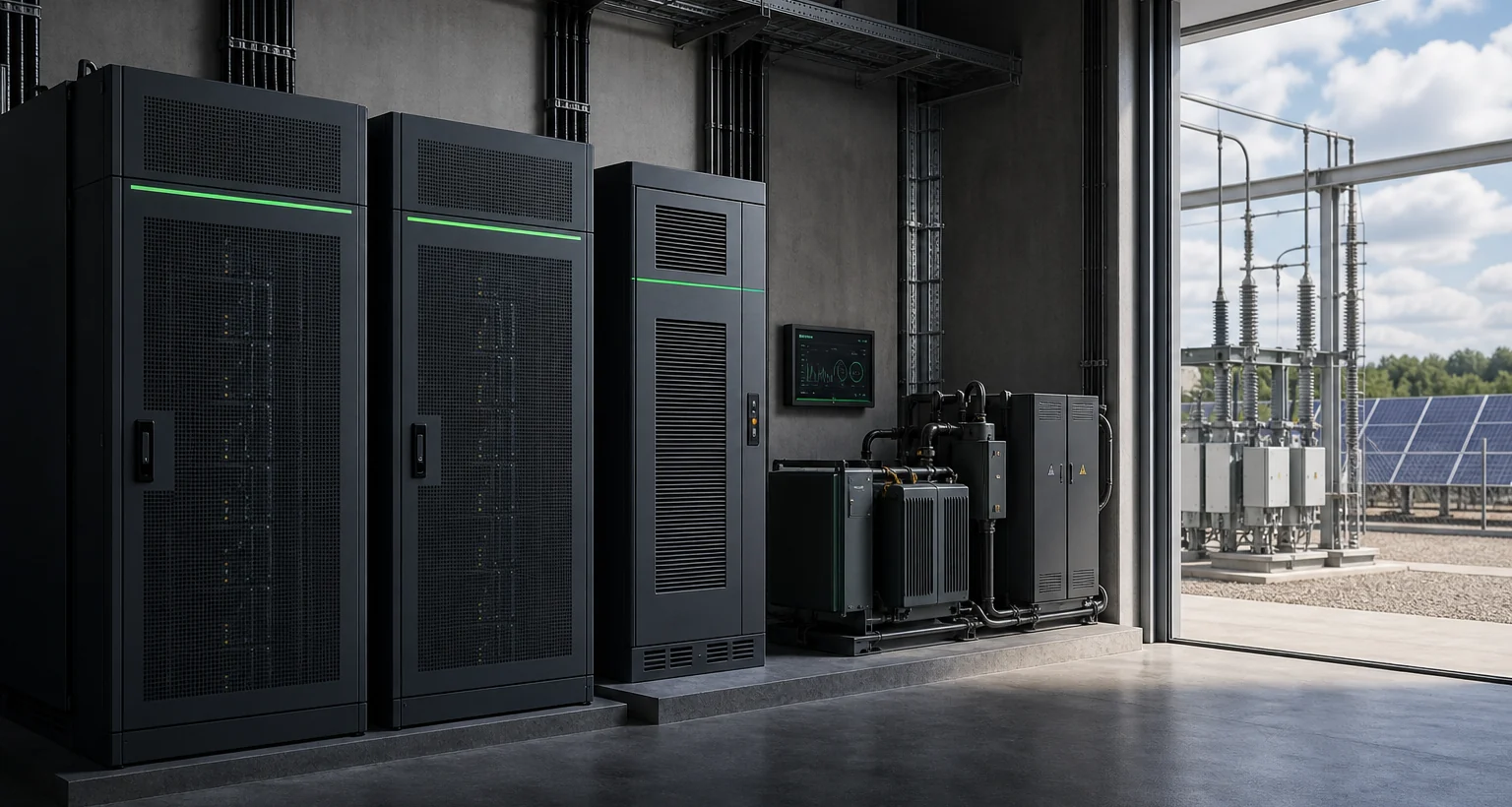
System integration
Match PCS power, battery cabinets and EMS as one system.
Check voltage window, current limits, communication, operating mode, transformer boundary and commissioning responsibility together.
PCS matching is not only a kW number beside a kWh number. A C&I ESS buyer needs to confirm voltage range, battery current, BMS protocol, EMS behavior, overload, grid phase, transformer assumptions and commissioning support.
Use this page before finalizing an outdoor cabinet or BESS container quotation.
Why matching fails
A battery and PCS can look compatible on a datasheet but still fail during setup if communication, current limits or grid settings are not aligned. Ask for tested parameter notes where possible.
Matching checklist
| Check item | What to request | Why it matters |
|---|---|---|
| Voltage range | Battery nominal voltage, operating window and PCS DC input range. | Avoids electrical mismatch. |
| Current limits | Max charge/discharge current and BMS protection points. | Prevents overload and nuisance alarms. |
| Protocol | CAN or RS485, firmware version, register notes and approved list. | Reduces commissioning delay. |
| Grid mode | Three-phase settings, backup mode, export control and reactive power. | Aligns PCS behavior with the site. |
| Support | Wiring diagram, parameter file, remote support and troubleshooting process. | Improves repeat installations. |
Project links
For deeper sizing, review PCS sizing for C&I battery storage. For site inputs, use the site survey checklist.
Questions that reveal whether the PCS and battery are truly matched
Ask the supplier to state the battery voltage window, maximum charge current, maximum discharge current, BMS protocol, PCS firmware version and supported operating modes. If the answer is only that the battery and PCS are compatible, ask for the tested configuration or setup notes.
The operating mode matters. Peak shaving, backup, self-consumption and off-grid support can use the same hardware in different ways. A PCS that is acceptable for one application may be undersized or configured incorrectly for another. The buyer should describe the load behavior and backup priorities before approving the model.
Commissioning support is part of matching. Ask whether the supplier provides a wiring diagram, parameter file, remote setup support, alarm explanation and troubleshooting flow. These items help the installer repeat the setup on the next project and reduce avoidable field delays.
Common matching mistakes
Common mistakes include choosing PCS power from nameplate battery capacity, ignoring BMS current limits, using the wrong CAN or RS485 protocol, forgetting transformer limits, and treating EMS logic as an optional accessory. Each mistake can make a technically good battery system difficult to operate on site.
Quotation review notes for PCS matching
The PCS portion of a quotation should state power rating, overload capability, grid mode, DC voltage range, communication protocol, EMS functions and commissioning support. If a quote only lists a PCS model without these details, the buyer should request clarification before approving the system.
The buyer should also ask how parameter settings are handled. Some suppliers provide a tested setting file or remote support session; others expect the installer to configure the system locally. This difference matters for distributors and installers who need repeatable deployment.
| Quote item | Question to ask | Risk if unclear |
|---|---|---|
| Included scope | Which battery, PCS, EMS, cooling, fire and document items are included? | The buyer may compare a complete system with a partial supply. |
| Responsibility | Who supports setup, troubleshooting, spare parts and warranty claims? | Problems can move between supplier, integrator and installer. |
| Evidence timing | Which documents are available before deposit, before shipment and after commissioning? | Important evidence may arrive too late to influence the purchase decision. |
FAQ
Is kW the same as kWh?
No. kW is power, while kWh is energy capacity. Both must match the load profile.
Which protocol is better, CAN or RS485?
The better protocol is the one tested by both PCS and BMS with the correct firmware and settings.
What should I send for matching review?
Battery voltage, capacity, BMS protocol, PCS model, load profile and grid phase.
Can EMS settings affect matching?
Yes. EMS logic controls charge, discharge, alarms and operating mode.
Should PCS sizing be checked before quotation?
Yes. It affects layout, heat, cable design and system price.
Verified matching windows
Match PCS and battery against the documented voltage range.
The nominal kW/kWh label is not enough. Verify DC operating window, AC connection, current, communication and operating mode together.
| Platform | Battery window | Power interface | Communication basis |
|---|---|---|---|
| 105/233 · 125/261.2 · 250/522.5 cabinets | 650–949 Vdc | 400 V AC | CAN / RS485 / Ethernet |
| 1.25/3.354 · 1.725/5.016 · 2.5/5.016 containers | 1040–1500 Vdc | 690 V PCS side | RS485 / CAN / Ethernet |
| 100 kW / 233 kWh hybrid | 650–949 Vdc | 380/400 V AC | CAN / RS485 / Ethernet / 4G |
| 219.24 kWh sodium-ion DC | 216–504 Vdc | DC-only to UPS | CAN / RS485 / Ethernet |
Related buyer guides
Continue with the next engineering decision.
Use the guide that matches the open sizing, electrical, safety or quotation question.
400 V vs 690 V BESS
Review current, cable, switchgear, transformer and AC interface implications.
Read guide2-hour vs 4-hour battery storage
Compare load shape, usable energy, SOC reserve, cycle duty and project economics.
2h vs 4h BESSLoad profile for a BESS quotation
Prepare interval demand, tariffs, PV, generators, critical loads and operating schedules.
Read guideContinue the project review
Connect the next decision.
Use the related page that matches the next equipment, engineering or evidence question.
Bring the site data. Leave with a clearer BESS scope.
Share the load profile, grid voltage, target kW and kWh, installation country, ambient conditions and expected schedule.