
C&I BESS procurement
BESS Round-Trip Efficiency: AC/DC Boundaries and Auxiliary Loads
A headline efficiency percentage is useful only when you know where the energy was measured, which loads were counted and how the system was operated.
The short answer
BESS round-trip efficiency (RTE) is electrical energy returned divided by electrical energy supplied over a defined charge-and-discharge cycle. Compare supplier values only when the AC or DC meter boundary, auxiliary loads, time window and operating conditions match. A maximum PCS efficiency is not whole-system round-trip efficiency. A cycle that ends with less stored energy than it started with is not a fair like-for-like comparison.
01 · Understand the metric
What does BESS round-trip efficiency measure?
RTE describes how much of the electricity used to charge a storage system is returned under a stated measurement basis. The U.S. Energy Information Administration defines it as the percentage of electricity put into storage that is later retrieved. That definition is a starting point, not a complete acceptance specification for an individual commercial battery cabinet.
Round-trip efficiency (%) = discharge energy returned ÷ charging energy supplied × 100
Use energy in kWh, not a ratio of two instantaneous power readings in kW. Identify the start and finish of the measurement, and use equivalent initial and final stored-energy conditions under the agreed method. Matching displayed SOC values is useful evidence, but SOC is an estimate: temperature, relaxation, balancing and the estimation method can affect whether the endpoints are genuinely comparable.
A usable-energy capacity test asks how many kWh are delivered on an agreed discharge basis. RTE asks how much charging input was required to obtain the returned energy. A capacity result alone cannot answer the efficiency question, and a high efficiency percentage does not establish a capacity guarantee.
Keep power capability separate as well. Meeting an efficiency criterion does not prove that the system can deliver the required continuous kW, reactive duty or backup behavior. Define those requirements independently in the project offer.
02 · Compare like with like
AC-to-AC and DC-to-DC are different boundaries
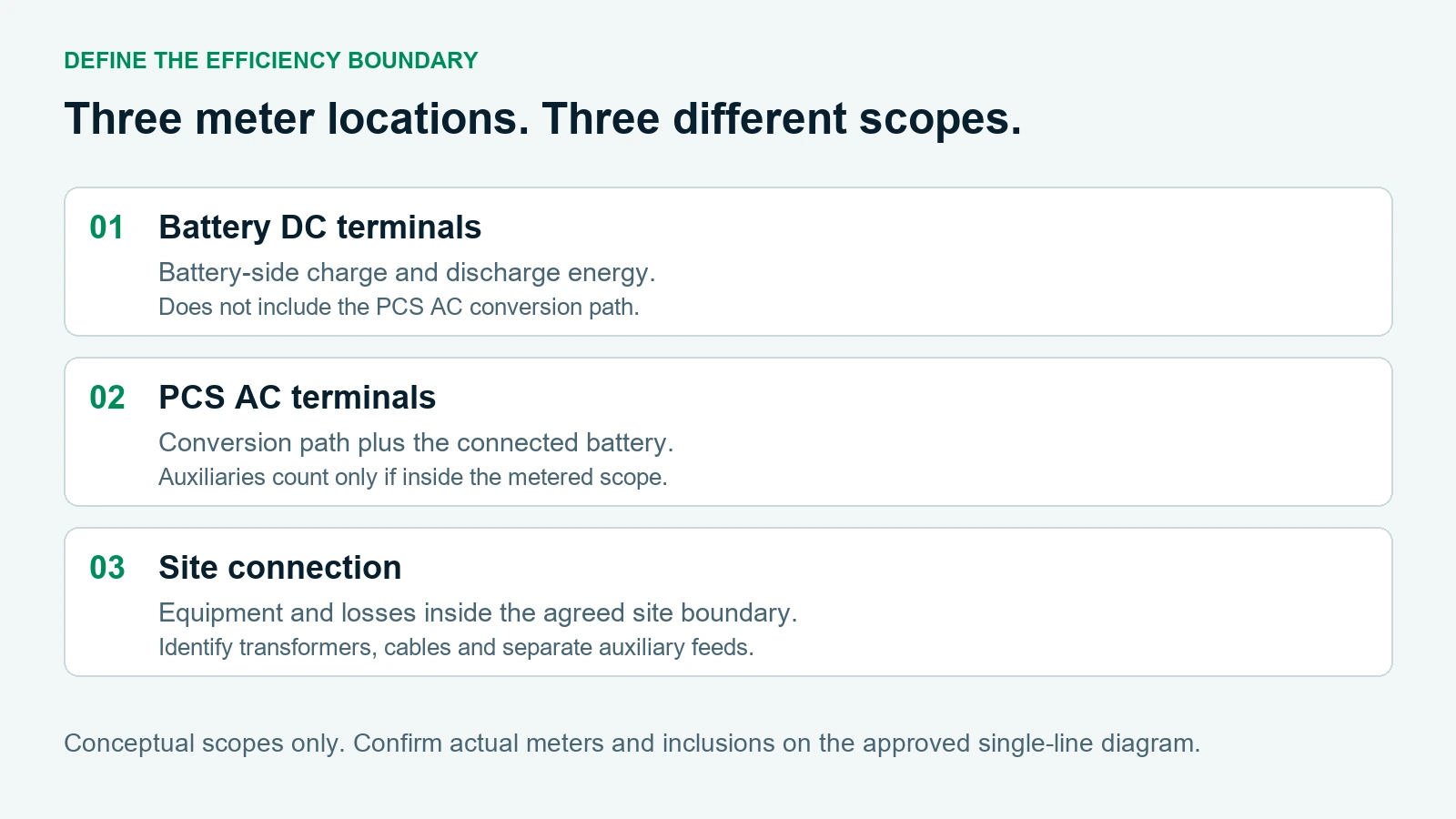
“Battery efficiency,” “PCS efficiency” and “system efficiency” can refer to different equipment. Ask the supplier to mark the energy meters on the single-line diagram and list every included loss. AC-to-AC is still incomplete wording if one quotation stops at the PCS terminals and another includes the site transformer and distribution path.
| Measurement basis | What it describes | What to clarify |
|---|---|---|
| Battery DC terminals | Charge and discharge energy at the defined battery-side DC points | Excluded converter losses; treatment of balancing, controls and separately supplied equipment |
| PCS one-way efficiency | Conversion in one direction under stated voltage, power and temperature conditions | Peak versus operating-profile performance; charging versus discharging; not a full storage cycle |
| PCS AC terminal RTE | A full charge/discharge cycle through the connected battery and converter path | Whether cooling, controls and other auxiliary feeders are captured |
| Site connection RTE | Energy across the agreed site measurement boundary | Transformer, cables, station service, unrelated site loads and any separate auxiliary supply |
Do not turn a converter’s maximum one-way efficiency into a promised BESS RTE. Charging and discharging can occur at different power, voltage and temperature, while the battery and auxiliaries introduce their own energy use. Even multiplying two headline converter efficiencies does not establish a measured whole-system result.
For AC-coupled or DC-coupled solar projects, identify which source charges the battery and where PV energy is metered. A site meter that mixes building demand, direct solar supply and battery flow may not isolate BESS input and output. The approved meter arrangement must separate those flows before a storage-efficiency claim can be checked.
03 · Account for every feeder
Count cooling, controls and standby energy once
Cooling equipment, pumps, fans, BMS and EMS controls, communications and other installed auxiliaries may consume energy during charging, discharge or idle periods. Identify the actual equipment; do not assume every cabinet has the same auxiliary architecture or load. The electrical supply path matters as much as the equipment list.
If an auxiliary feeder is already inside the main meter boundary, its effect is already represented in the recorded input or net output. If it is supplied separately outside those meters, the agreed wider-boundary calculation may need that separate input added. Do not add or subtract auxiliary consumption twice. Record the signed energy flows and use the accounting method approved for the project.
Illustrative example: the same equipment, two reported scopes
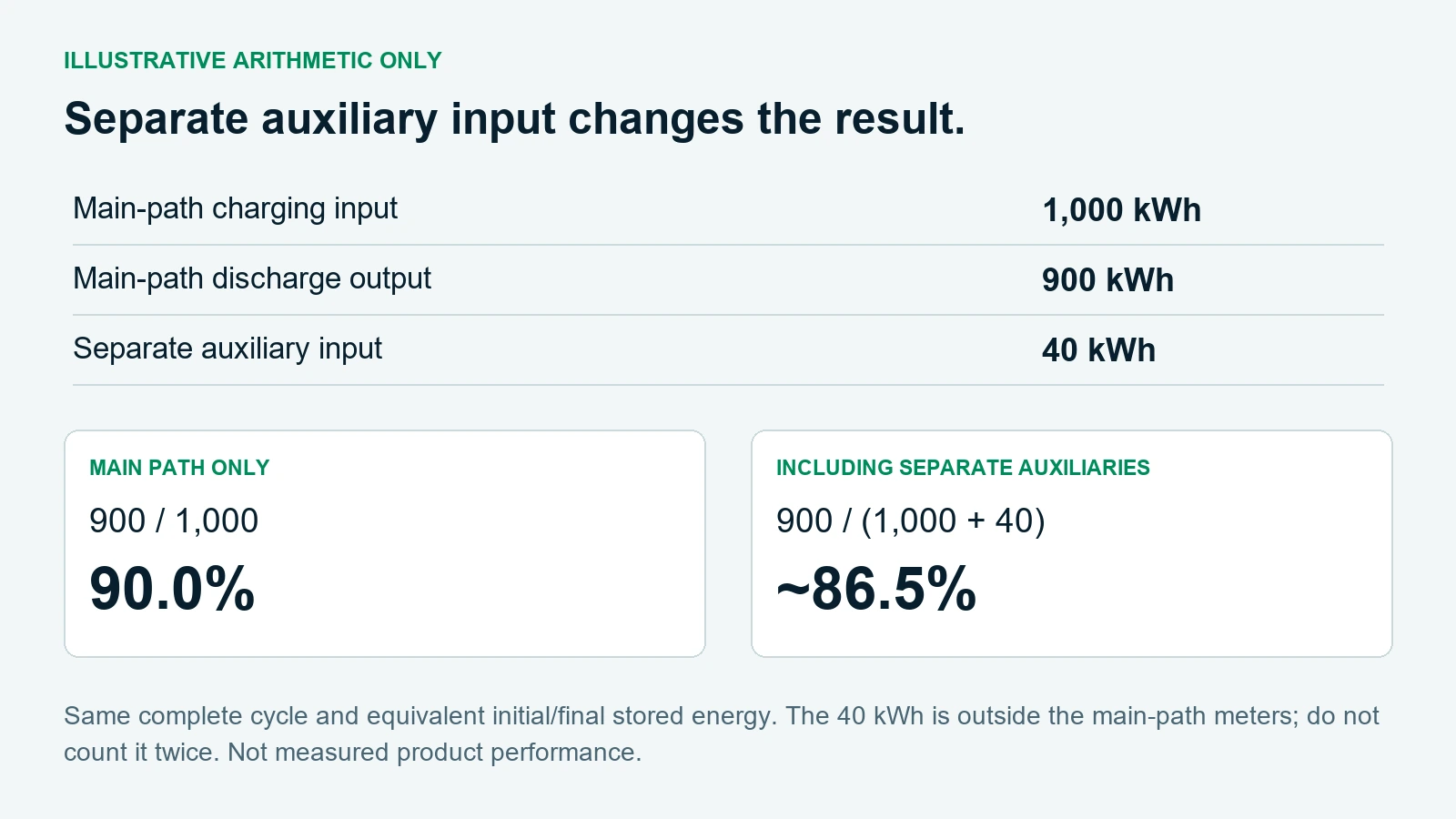
Assume an isolated storage cycle with no PV or unrelated site load. The main AC-path meters record 1,000 kWh supplied and 900 kWh returned. A dedicated auxiliary feeder, outside those main-path meters, supplies another 40 kWh over the same complete interval. Initial and final stored-energy conditions are equivalent under the agreed method.
- Main-path-only ratio: 900 ÷ 1,000 × 100 = 90.0%.
- Including the separate auxiliary input: 900 ÷ (1,000 + 40) × 100 ≈ 86.5%.
These are invented values for arithmetic only, not ELECNO performance, a laboratory result or an expected project outcome. If the 40 kWh were already included in the 1,000 kWh input or the metered net output, this adjustment would be wrong.
State the time window explicitly. A cycle test that excludes a long standby period answers a different question from an operating-period assessment that includes that standby consumption. Fixed energy use can have a larger proportional effect when little energy is cycled. Neither metric should be relabeled as the other without an agreed calculation basis.
04 · Make results repeatable
Align the conditions before comparing percentages
Two results at the same meter boundary can still be incomparable. Request the charge/discharge profile rather than just a rated-power label, along with the battery voltage or SOC range, temperature conditions, endpoint method, dwell time and equipment condition. A short test at a favorable operating point does not represent every dispatch schedule.
- Power and profile: record charge and discharge commands, measured energy and limiting events across the test.
- Energy window: identify the permitted SOC or voltage range, reserves, endpoint method and any conditioning outside the measured interval.
- Temperature: state ambient and relevant available battery/cooling measurements, stabilization assumptions and thermal-management operation.
- Time: define charging, discharge, rest, standby and any warm-up or preconditioning periods included or excluded.
- Equipment baseline: identify unit configuration, firmware/settings, age or relevant operating history, and any restrictions.
- Metering: identify meter locations, accuracy or calibration basis, time synchronization, sampling/integration method and data gaps.
A fleet average, a simulation assumption and an acceptance-test result are different kinds of evidence. Do not use a historical industry statistic as a model guarantee. For a guaranteed threshold, the contract should identify the procedure, tolerances, responsible witness, reporting format and treatment of an invalid or failed test.
This is a procurement and measurement-planning guide, not an instruction to connect temporary meters, change protection or operate outside approved limits. Electrical installation and testing require qualified authorized personnel and the applicable equipment, site and safety procedures.
05 · Turn the claim into evidence
What should an efficiency RFQ request include?
Give each supplier the same duty and comparison sheet. A useful response connects the quoted percentage to an identifiable configuration and a reproducible method. Use the BESS quote comparison checklist for the wider supply scope; add the following efficiency questions rather than ranking offers by an unexplained headline value.
- Name the metric: battery DC RTE, PCS AC RTE, site-boundary RTE or operating-period energy balance.
- Draw the boundary: meter locations, transformer/cable scope, auxiliary feeders and other source/load flows.
- Specify the duty: charge/discharge profile, usable-energy window, reserve and included idle time.
- State conditions: temperature, endpoint method, equipment condition and settings.
- Define evidence: source energy readings, time-aligned logs, instrument basis and calculation sheet.
- Agree acceptance: the project-specific threshold, tolerances, exclusions, retest rules and responsible signatories.
Ask whether the value is an indicative datasheet statement, a modeled expectation or a contractual guarantee. If the supplier cannot provide the supporting test basis yet, record that as an open item rather than assuming the value includes the entire plant.
The EMS commissioning checklist is useful for verifying meter mapping, time alignment and signal direction. It does not replace an efficiency test, but incorrect metering or mixed site loads can undermine the result before the arithmetic starts.
06 · Keep the decision honest
Five efficiency comparisons to avoid
- Comparing a peak one-way PCS value with a full-cycle system result.
- Comparing a DC battery boundary with an AC site boundary.
- Counting separate auxiliary consumption twice, or omitting it without saying so.
- Comparing cycles with different stored-energy endpoints, duty or standby windows.
- Converting an efficiency percentage directly into a guaranteed electricity-bill saving.
Project economics also depend on tariffs, dispatch, available throughput, degradation assumptions, availability, reserve policy and the site demand profile. An efficiency ratio is one input, not an ROI calculation. Keep those assumptions visible instead of promising a universal saving.
For an ELECNO project inquiry, send the proposed BESS configuration, single-line diagram, intended dispatch, site conditions and requested meter boundary. Zhengzhou ELECNO can use those inputs to discuss the quotation and evidence scope; the final performance basis must be agreed for the actual project.
Buyer questions
Frequently asked questions
What is BESS round-trip efficiency?
BESS round-trip efficiency is the electrical energy returned divided by the electrical energy supplied over a defined charge-and-discharge cycle, expressed as a percentage. The meter boundary, auxiliary-load accounting, start and finish conditions, operating profile and time window must be stated for the result to be comparable.
Is PCS efficiency the same as BESS round-trip efficiency?
No. A PCS efficiency value can describe one direction and one operating point of the power converter. Whole-system round-trip efficiency includes both charge and discharge and the losses and auxiliary consumption inside the agreed measurement boundary. A maximum PCS efficiency is not a system round-trip guarantee.
Should cooling and standby power be included in BESS efficiency?
They should be included when they fall within the defined system or operating-period metric. Identify every auxiliary feeder and whether its energy is already captured by the main meters. State whether charging, discharge, idle periods and temperature conditioning are covered. Do not add or subtract the same consumption twice.
What is a good round-trip efficiency for a commercial battery cabinet?
There is no useful universal pass value without a common measurement boundary and duty. Compare offers at the same power profile, usable-energy window, temperature, auxiliary treatment, idle period and equipment age. Ask for a project-specific acceptance criterion and supporting evidence instead of comparing unexplained headline percentages.
How is round-trip efficiency different from a usable-energy capacity test?
A usable-energy test measures delivered energy under an agreed discharge and measurement basis. Round-trip efficiency compares both charging input and discharging output over a defined cycle. A delivered-kWh result alone cannot establish round-trip efficiency, and a high efficiency ratio alone does not establish guaranteed capacity.
Definition source and editorial scope
The EIA source linked above supports the general definition of round-trip efficiency. Its historical fleet data are not used here as an ELECNO specification, current market benchmark or individual-project target. The diagrams and numeric example in this article are explanatory, not measurement records. No universal efficiency guarantee is implied.
Ask what the percentage includes.
Align the equipment boundary, operating conditions and evidence before accepting a BESS efficiency claim.