Key takeaways
- Do not confuse the battery DC voltage window with the PCS AC output voltage.
- At the same three-phase power, higher AC voltage reduces current and can change cable and switchgear architecture.
- Confirm transformer, protection, grounding and metering responsibilities in one preliminary SLD.
Decision framework
Use this table to align the technical question before comparing equipment or supplier proposals.
| Design area | 400 V AC interface | 690 V AC interface |
|---|---|---|
| Common starting point | Commercial LV boards and smaller cabinet systems | Higher-power PCS blocks feeding a project transformer |
| Current at equal power | Higher | Lower |
| Switchgear integration | May connect into an existing 400 V distribution boundary | Often uses dedicated 690 V switchgear and transformer winding |
| Transformer question | Existing LV capacity and fault duty must be checked | Step-up transformer is usually explicit in the project scope |
| Main risk | Underestimating current, cable route and existing-board limits | Treating the PCS voltage as the final site interconnection voltage |
Separate DC and AC voltage definitions
Battery racks operate over a DC voltage window. The PCS converts that DC energy to a specified three-phase AC voltage. A project may therefore use a high-voltage DC battery bus, a 690 V PCS output and a medium-voltage grid connection through a transformer. Each boundary needs its own rating and protection definition.
RFQs should state battery DC window, PCS AC output, site bus voltage and point of common coupling separately. Ambiguous use of the word voltage is a frequent cause of mismatched quotations.
Voltage changes current and balance of system
For the same three-phase power, current is inversely related to voltage after power factor and efficiency are considered. Lower current can reduce parallel cable count and change switchgear selection, but it does not automatically reduce total project cost. Dedicated 690 V equipment and transformer design may add scope that is not present in a smaller 400 V connection.
Check continuous current, overload, fault level, cable length, voltage drop, ambient derating and installation method. The correct comparison is the complete electrical path, not only the PCS terminal.
Resolve transformer and protection scope
Confirm transformer vector group, impedance, taps, cooling, losses, enclosure, neutral and grounding approach with the project electrical engineer. Protection coordination should cover PCS, LV switchgear, transformer and MV interface, including trip ownership and communication to the EMS or plant controller.
Revenue metering, auxiliary supply and black-start assumptions also belong on the SLD. If the system must island or resynchronize, the operating sequence is as important as the voltage rating.
Choose from the site outward
A 400 V cabinet can be a practical starting point for distributed C&I loads when the existing LV board has adequate capacity. Container systems commonly use a 690 V PCS stage before project step-up. The final selection depends on grid connection, power block size, cable route, fault duty and local equipment availability.
Compare the documented 400 V cabinet and 690 V container interfaces in the C&I LFP energy storage systems portfolio, then confirm the selected model against the project single-line diagram and responsibility boundary.
Project requirements, local codes and site conditions take precedence over this general buyer guide. Final system design should be reviewed by qualified project professionals.
Starting configurations
Compare documented platforms.
Use these configurations for screening, then confirm usable energy, electrical boundary and responsibility scope for the site.
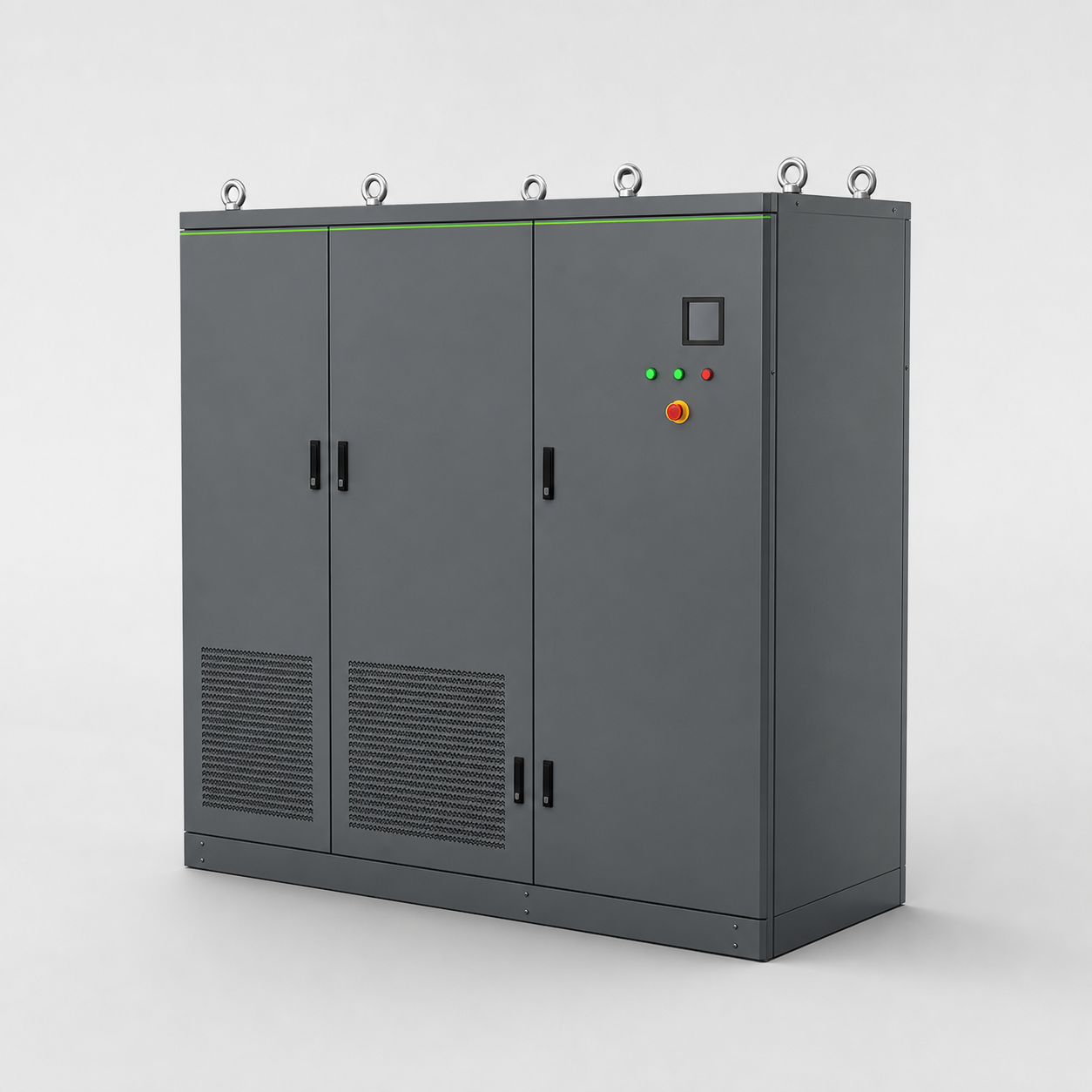
105 kW / 233 kWh Cabinet
Compact 400 V AC cabinet platform for distributed C&I sites.
View product →250 kW / 522.5 kWh Cabinet
Higher-power cabinet with dual battery strings and dual PCS architecture.
View product →1.25 MW / 3.354 MWh Container
Energy-led container platform with a 690 V PCS stage and project step-up interface.
View product →Buyer questions
Frequently asked questions
Is 690 V always better than 400 V for BESS?
No. 690 V can reduce current at equal power, but transformer, switchgear, equipment availability and the existing site bus determine the best project architecture.
Is battery voltage the same as PCS output voltage?
No. Battery voltage is DC and varies across its operating window. PCS output is the three-phase AC interface to switchgear or a transformer.
Can a 400 V BESS connect to a medium-voltage grid?
Yes, through a suitable step-up transformer and protection system designed for the project.
What electrical data should an RFQ include?
Include site bus voltage, frequency, fault level, transformer data, grounding, cable distance, point of connection, protection requirements and operating mode.
Match the requirement to a documented configuration.
Use measured site data, a clear electrical boundary and a shared responsibility matrix to request a comparable proposal.